
ESG Reporting Needs Continuous Sensor Data, Not Annual Snapshots
Why your ESG report is only as good as your last sensor reading
Green building certifications gave the property sector a shared language for sustainability. LEED, BREEAM, Nordic Swan Ecolabel – these frameworks defined what “better” looks like and created a way to compare buildings against each other. That was the hard part, and it took decades.
But there’s a growing gap between what a certification says about a building and what that building is actually doing on any given Tuesday in February.
Why annual ESG reporting in property falls short
A LEED certification tells you that a building met specific criteria at a point in time. It says nothing about whether the HVAC system drifted out of spec six months later, whether the ventilation rate still meets the threshold during peak occupancy, or whether energy consumption crept up 12% because someone overrode a setpoint and forgot about it.
ESG reporting in property has inherited this same snapshot mentality. Once a year, someone pulls together numbers, assembles a narrative, and submits it. The numbers are real, but they’re historical. They describe what happened, not what is happening.
This is the gap that critics of ESG are actually pointing at when they talk about greenwashing in real estate. The issue isn’t that property owners are lying. Most aren’t. The issue is that annual reporting creates an accountability gap wide enough to park a data center in.
Green building certifications got us the vocabulary. Now we need the receipts.
The Arc/GBCI team made this argument well in their 2022 piece on green building as ESG infrastructure: certifications provide a “credible, defensible foundation” because they represent specific actions aligned with publicly available criteria. That’s true. But it’s also incomplete.
A certification proves you did the right things. Continuous sensor data proves you’re still doing them.
This distinction matters more now than it did five years ago. The EU’s Corporate Sustainability Reporting Directive (CSRD) is pushing property companies toward more granular, more frequent disclosure. Investors increasingly want to see operational performance data, not just design-stage credentials. GRESB scores now weight performance indicators heavily alongside management indicators.
The sector is moving from “show me your certificate” toward “show me your numbers, continuously.”
What continuous ESG compliance looks like in practice
Here’s the practical version. A building has sensors already – temperature, humidity, CO2, energy meters, airflow rates. Most BMS platforms collect thousands of data points per hour. The vast majority of those readings are never used for ESG purposes. They sit in a time-series database somewhere, occasionally pulled into an engineer’s dashboard when something breaks.
Continuous compliance means mapping those sensor streams to certification criteria and regulatory thresholds in real time. It means knowing, right now, whether your indoor air quality meets Nordic Swan requirements – not finding out during next quarter’s audit that it hasn’t for three months.
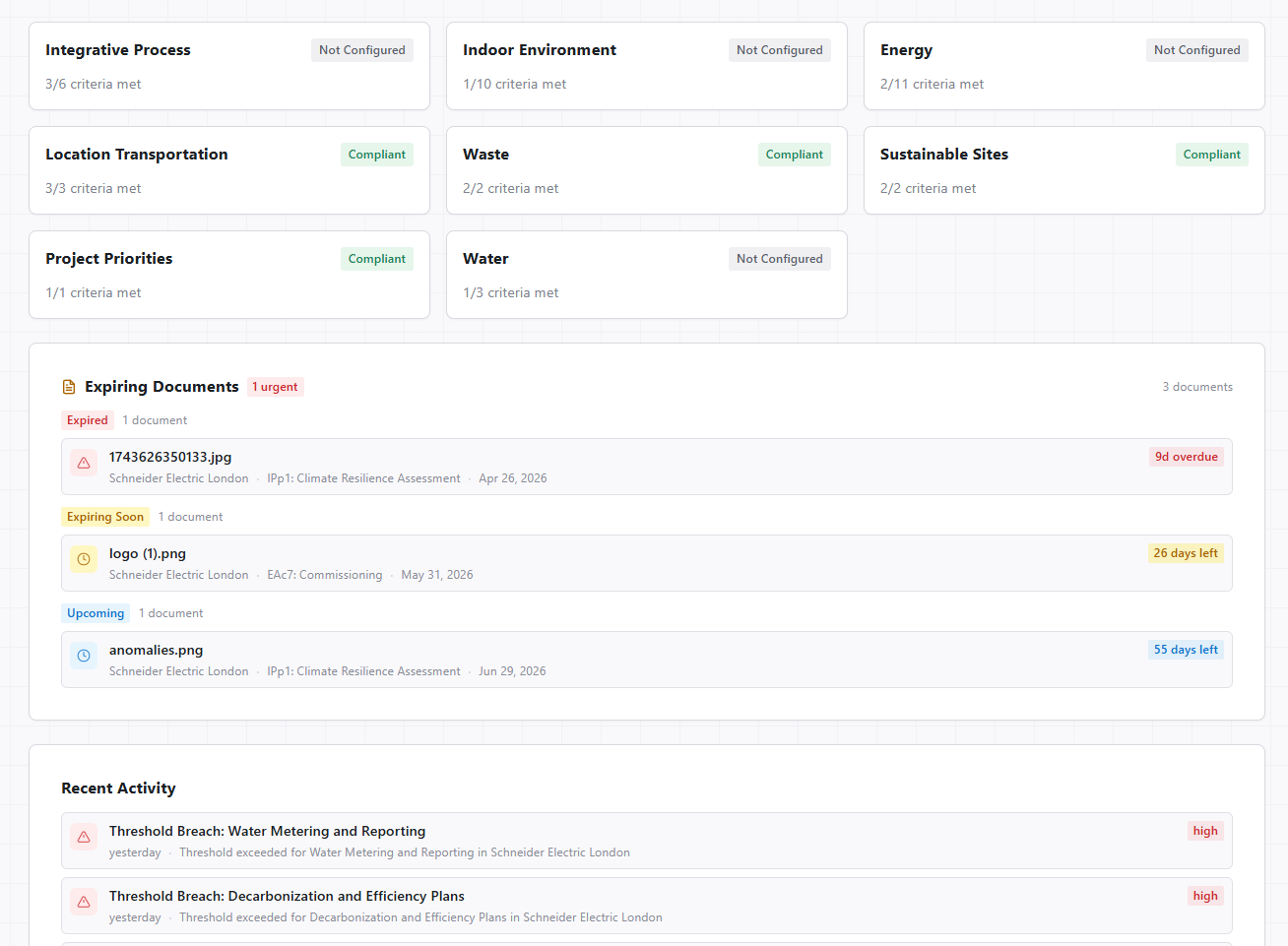
At FrostLogic, we built Explore’s compliance tracking around this idea. The system maps existing sensors to certification requirements automatically. When a threshold is breached, the alert happens immediately, not after a consultant reviews a spreadsheet.
The result is that ESG reporting stops being a retrospective exercise and becomes a live status. You can answer “are we compliant right now?” on any given day. And because the data is continuous and timestamped, the audit trail builds itself.
How AI turns raw building sensor data into ESG evidence
Raw sensor data isn’t useful for ESG by itself. A building generating 10,000 readings per hour produces noise alongside signal. Someone (or something) needs to determine which anomalies matter, which drift patterns indicate a real problem versus seasonal variation, and what the probable cause is.
This is where AI earns its place in the ESG stack. Not as a report-writing tool, but as a pattern recognition layer that identifies when building performance deviates from what certifications and regulations require.
Our approach uses six anomaly detection methods with causal filtering. The “causal” part matters: when Floor 3 temperature spikes and AHU-7 shows increased load at the same time, the system connects those signals rather than generating two separate alerts. It also means forecasting – predicting when a metric will breach a threshold before it happens, giving operations teams time to act rather than react.
The what-if simulation capability takes this further. Before changing a setpoint or schedule, you can model the impact on compliance metrics. Will reducing nighttime ventilation to save energy push CO2 levels above the BREEAM threshold during the first morning hour? Better to find out in simulation than in an audit.
Scaling ESG sensor data across property portfolios
Single-building owners can sometimes manage ESG manually. Portfolio operators cannot. When you’re reporting across 50 or 200 buildings, the manual approach (consultants, spreadsheets, annual collection cycles) doesn’t just become expensive – it becomes unreliable. Inconsistent measurement, different equipment vintages, varying local regulations. The complexity compounds.
A technology layer that standardizes how sensor data maps to ESG criteria across a portfolio changes the economics entirely. The portfolio manager sees compliance status across all properties at once. The ESG team gets export ready evidence when reporting deadlines arrive instead of spending six weeks collecting it.
This isn’t replacing green building certifications. It’s giving them teeth. Certifications define the standard. Sensor intelligence proves you’re meeting it, continuously, with evidence that’s harder to dispute than a self-assessment questionnaire.
Curious where your building stands? Try our free Building Intelligence Score assessment.
The uncomfortable next step for property ESG
ESG reporting in property is heading toward the same cadence as financial reporting. Quarterly disclosures. Investor-facing dashboards. Evidence that holds up to the same scrutiny as a balance sheet.
Most property companies aren’t ready for that. The ones with sensor infrastructure and a data layer will adapt. The ones still doing annual manual collection will find themselves explaining gaps they didn’t know they had.
We think green building certification was the first step – defining what matters. The second step, which the industry is in the middle of right now, is proving it continuously with actual building data. Not because regulators demand it (though they increasingly do), but because anything less is just… claims.
FrostLogic Explore is an AI-powered sensor intelligence platform that turns building data into compliance tracking, anomaly detection, and operational decisions. Learn more about Sensor Intelligence or request a demo.