FrostLogic Explore

Sensor intelligence: how AI turns building data into decisions

Turn your existing BMS, IoT, and energy sensors into prioritised, explainable decisions — without ripping anything out.

Sensor intelligence is the AI layer that reads your building's signals for you. It ingests data from the sensors you already have, validates it, detects what matters, forecasts what comes next, and recommends the action a facility manager should take — instead of producing one more dashboard nobody opens.

What it is

What is sensor intelligence?

Sensor intelligence is what happens when AI starts reading your building's signals for you. An AI sensor platform ingests data from your BMS, IoT systems, and energy meters; validates each signal against expected behaviour; detects the anomalies that matter; forecasts what comes next; and recommends a prioritised action — not just another chart. Where traditional building sensor analytics historically meant "log everything and graph it," smart building AI does the reading and reasoning so your team can stop monitoring and start operating. The distinction matters because it changes who is responsible for noticing problems. With a dashboard, that responsibility sits with whichever human happens to be looking. With sensor intelligence, it sits with the platform — twenty-four hours a day, across every signal, every site.

Raw signalsnoise
AI
Prioritised decision
AHU-7 supply-air drift detected — review setpoint
The gap

The gap between data collection and data-driven decisions

Most buildings already collect more data than their teams could ever read. A medium commercial property generates millions of sensor readings a year — temperatures, pressures, energy draw, occupancy, valve positions, fan speeds, CO2, supply-air flow. Almost none of it turns into a decision. The signal exists; the path from signal to action does not. That is the gap sensor intelligence closes. It treats every reading as a question the AI should already be answering before a human asks it, and surfaces only the handful of items a person needs to act on today.

The shift

Why dashboards aren't enough

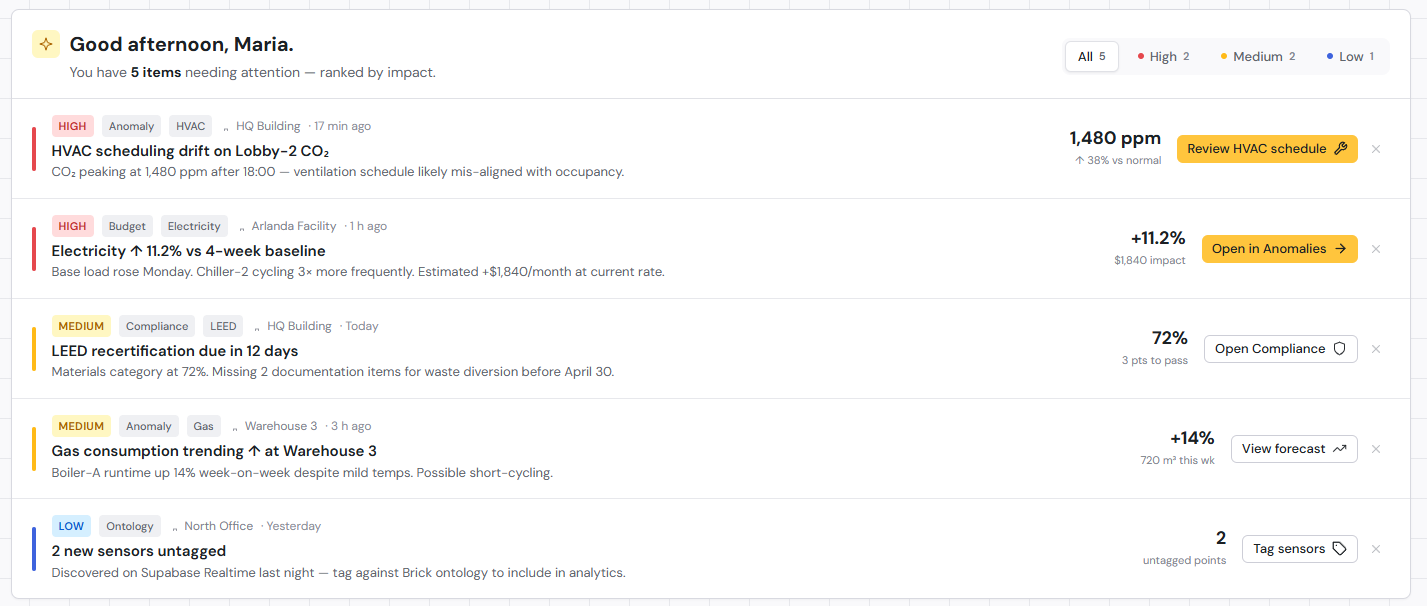
Traditional BMS dashboards and building analytics platforms are visualisation-first. They assume a person will look at them, notice something off, and follow up. That assumption breaks at scale: nobody watches the dashboard at 03:00 when an AHU starts drifting, and nobody opens it in time to catch an energy creep before it shows up on the invoice. An AI sensor platform inverts the model. It watches continuously, prioritises by impact, and pushes the three things that matter most to the people who can act — instead of waiting to be asked.

How it works

How sensor intelligence works

Under the hood, sensor intelligence is a five-stage pipeline. Each stage is a discrete responsibility — when one part fails, you know exactly where to look. FrostLogic Explore implements all five, sitting on top of the data infrastructure you already run.

01

Ingest

Sensor readings stream in from BMS systems, IoT platforms, and energy meters via standard protocols. No rip-and-replace — sensor intelligence connects on top of the infrastructure you already have, normalising units and timestamps as data arrives.

02

Validate

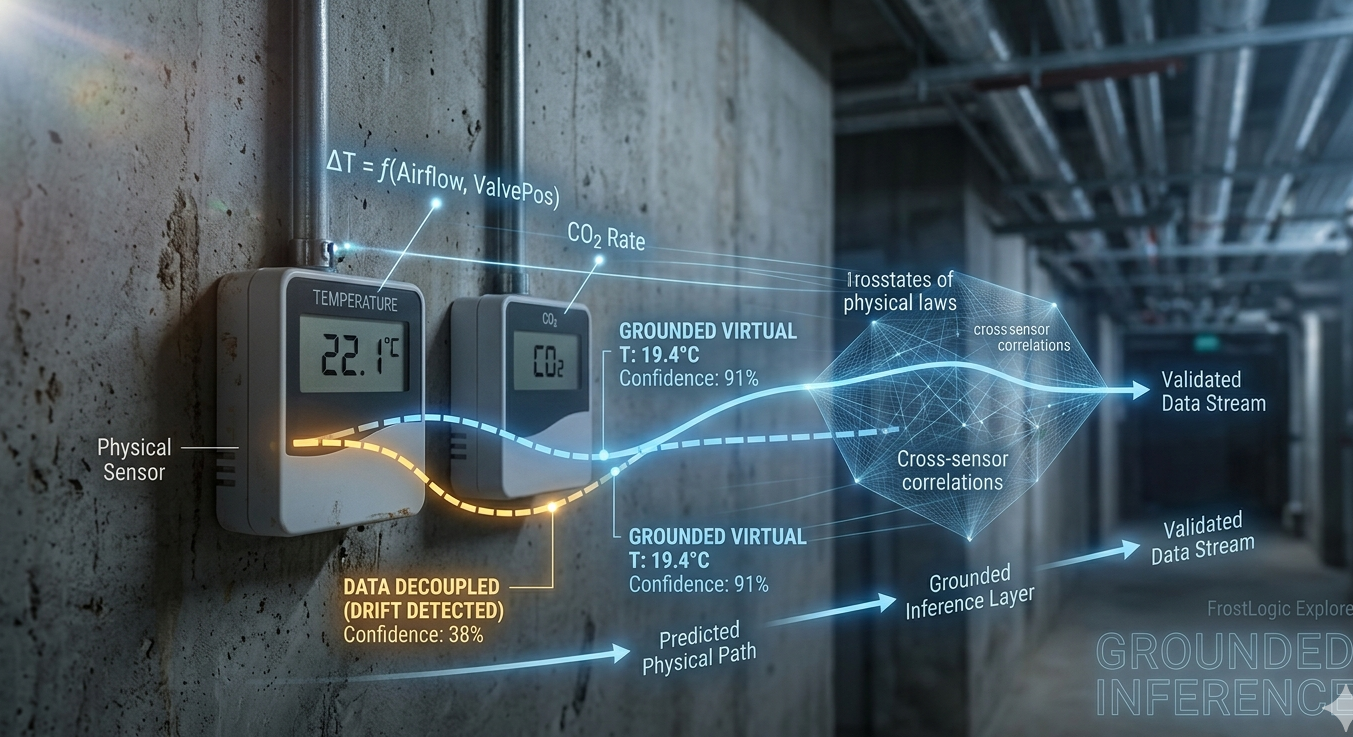
Each signal is checked for missing values, stuck sensors, calibration drift, and unit mismatches. Building sensor analytics is only as good as the data underneath, so validation runs before anything else — bad data never reaches the reasoning layer.

03

Detect

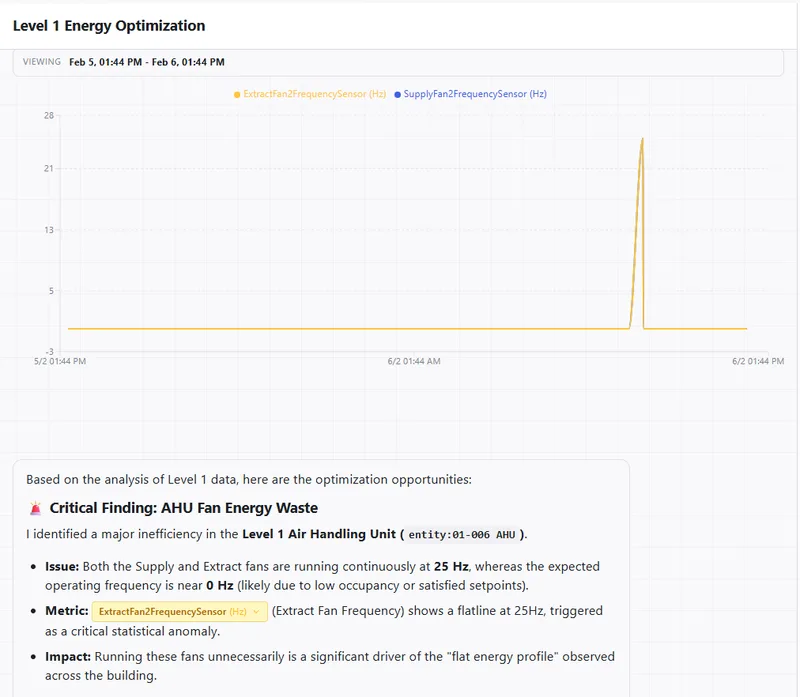
Six complementary anomaly methods score every reading for severity and classify it: repeating deviations, drift signatures, correlated anomalies, threshold breaches, statistical outliers, and causal anomalies. Noise stays out; real problems surface first, ranked by impact.

04

Forecast

Multiple forecasting horizons predict energy demand, temperature trends, and equipment behaviour. You see what the next hour, the next shift, and the next week look like — and you can run a what-if simulation against any of them before changing a setpoint.

05

Recommend

An AI reasoning layer explains what it found, ranks it by impact, and proposes the next action. Recommendations are grounded in your actual sensor data with deterministic guardrails — the model never invents a number it cannot point at in the underlying telemetry.

The same pipeline mapped onto the system architecture: your existing data sources at the bottom, the sensor intelligence layer in the middle, prioritised decisions at the top.

Output
Decisions & Actions
Prioritised, explainable outputs
Intelligence
FrostLogic Explore
Frostdynamics™ AI
Data Source
Your Existing Platform
Telemetry, SCADA, IoT platforms
What it solves

Five problems sensor intelligence solves

Every facility manager, asset manager, and operations lead we talk to recognises some version of these. They are the everyday cost of running buildings without a decision layer sitting on top of the data.

01Problem

HVAC drift detected too late

Setpoints slip, valves stick, and economisers stop economising — quietly, over weeks. By the time a tenant complaint lands, you have already paid for it in energy and comfort. Sensor intelligence catches drift the day it starts, not the month it becomes obvious.

02Problem

Energy costs that creep up invisibly

Baseline energy consumption rises a percent or two a quarter. It never trips an alarm, but it doubles your operating cost in five years. Forecasting against your live baseline makes the creep visible the week it starts — before the invoice does.

03Problem

Certification compliance gaps between audits

Nordic Swan, BREEAM, LEED — most frameworks are audited once a year. The other fifty-one weeks, nobody actually knows whether you are still inside the criteria. Continuous, sensor-driven compliance tracking closes that window and keeps evidence audit-ready year-round.

See continuous compliance in practice →
04Problem

Equipment failures that could have been predicted

Chillers, AHUs, and pumps rarely fail without warning. They fail after weeks of subtle pattern changes that nobody read in time. Pattern-based anomaly detection turns those weeks into a planned-maintenance ticket instead of an emergency call-out at 02:00.

Read the sensor validation case study →
05Problem

Manual reporting that eats facility manager time

If your facility lead spends Mondays assembling KPI reports from CSV exports, that is the first thing sensor intelligence eliminates. Reports become standing artefacts the platform produces continuously, freeing the team to act on what they say.

Buyer's guide

What to look for in a sensor intelligence platform

Most platforms sold as "building AI" are dashboards with an AI label. If you are evaluating an AI sensor platform, these are the four criteria we would push you to grade every vendor on — including us.

01
Criterion

Grounded AI (no hallucination)

The AI should reason over your actual sensor data, not over the public internet. Ask any vendor how they prevent the model from inventing values, and what their deterministic guardrails look like. If the answer is "the LLM might mention something not in the data, but it usually doesn't," walk away. Sensor intelligence only works when every number on screen has a sensor behind it.

02
Criterion

Decision-first output, not just visualisation

A good sensor intelligence platform tells you what to do next, not just what is happening. Outputs should be prioritised, explainable, and ranked by impact — so a facility manager can act on the top three items today instead of scrolling through forty charts. If the demo opens with a wall of graphs, it is a dashboard with extra steps.

03
Criterion

Multi-framework compliance support

Whether you are targeting Nordic Swan today, BREEAM next year, and LEED for an EU-wide rollout the year after, the platform should map sensors to criteria once and reuse that mapping across frameworks. Anything less locks you into the certification you started with — and makes the next one a manual project all over again.

04
Criterion

Deployment flexibility (SaaS vs. on-prem)

Some organisations need a managed SaaS; others need to run the intelligence inside their own Kubernetes cluster for data sovereignty or governance reasons. A serious smart building AI platform supports both — the same intelligence layer, the same model, on either side of the line. If you can only get it one way, you are choosing the vendor's roadmap over your own.

Deployment Options

Enterprise / Customer-Hosted

  • Runs in your K8s cluster or private cloud
  • Your infra, your SLAs, your governance
  • You own data and trained model
  • Full control, your pace

Managed SaaS

  • Hosted on Hetzner, EU-based
  • ISO 27001 certified, GDPR compliant
  • Data sovereignty maintained
  • Fast onboarding, no infra setup
No PII — building and operational sensor data only
Grounded inference with deterministic guardrails — no hallucination
No vendor lock-in — your data and models are always exportable
Kubernetes-native — runs anywhere containers run
FrostLogic Explore

FrostLogic Explore: sensor intelligence in production

Explore is our productised sensor intelligence platform. It ships with the full five-stage pipeline above, six anomaly detection methods, multi-horizon forecasting, what-if simulation, an AI reasoning layer that explains what it sees, and certification compliance support — running on top of the data infrastructure you already have.

What's in the box

Accurate Forecasting

Predict energy demand, temperature trends, and equipment behaviour with multiple forecasting horizons.

Virtual Sensors

Create calculated metrics from existing sensors — fill data gaps without installing new hardware.

Advanced Anomaly Detection

Six methods with causal filtering ensure you see real problems, not noise.

What-If Simulation

Causal intelligence discovers why metrics change — then lets you test changes before making them.

AI-Powered Reasoning

A conversational AI assistant that answers questions about your building using your actual sensor data.

Scalable Signal Processing

From a single building to a portfolio — the same intelligence layer scales without architectural changes.

FrostLogic Explore

See what your sensor data is telling you

Book a 20-minute demo. We will connect to a sample of your data and show you what Explore surfaces — live. Or take the diagnostic first.

FrostLogic Explore
Frostdynamics™ AI
Decisions & Actions
Prioritised, explainable outputs
Managed SaaS
ISO 27001 certified, GDPR compliant