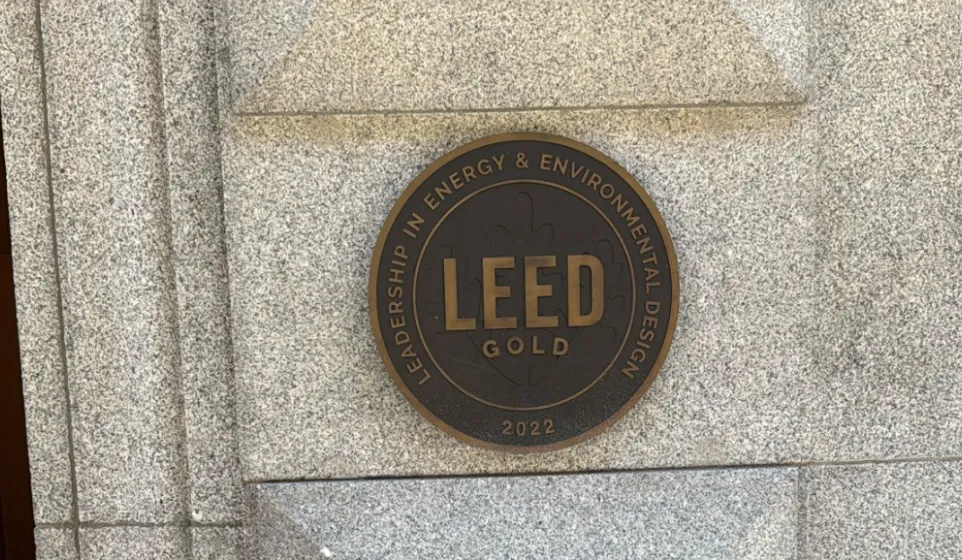
BREEAM Excellent. LEED Platinum. Nordic Swan Ecolabel. Buildings collect these plaques in their first year, hang them in the lobby, and then drift – often quietly – for the next decade.
The drift is well documented. A 2018 review of 121 LEED-certified buildings found that over half deviated more than 25% from their predicted energy use intensity. In low-energy buildings the gap runs from -86% to +483%, with an average overshoot of 58%. One UK study of 50 modern buildings found they were using up to 3.5 times the energy their designs allowed for, and producing 3.8 times the predicted carbon. The certificate on the wall said one thing. The building was doing another.
That is the gap continuous compliance tracking is trying to close.
The problem with annual certification audits
Certification is a snapshot. The auditor arrives, runs through the criteria, ticks the boxes that pass, flags the ones that don’t, and leaves. The building gets a certificate that says “compliant on [date].” Between that date and the next audit, anything can happen.
Usually nothing dramatic does. A setpoint gets overridden during a heatwave and never reset. A ventilation damper gets stuck at 40% open instead of 80%. A submeter drops offline and nobody notices because the energy bill aggregates. An HVAC schedule gets adjusted to fix a comfort complaint and quietly violates the certification’s nighttime ventilation requirement. None of these show up on a dashboard as a problem. They show up at the next audit as a non-compliance finding, and by then the building has been operating that way for six or eighteen months.
The financial side of this is increasingly hard to ignore. In Boston, larger nonresidential buildings now face penalties of $1,000 per day for missing emission standards and $300 per day for failing to report. Seattle’s $10 per square foot penalty structure means a 5% performance gap on a 200,000 sq ft asset becomes a six-figure annual problem. Denver levies tens of thousands per year against properties running 15% over their EUI target. Asset prices are starting to reflect the exposure. Buyers discount for the cost of bringing a non-compliant building back to spec, and lenders increasingly want to see operating performance data before they price the loan.
Annual audits also have a workflow problem. The weeks before an audit are a scramble: pulling spreadsheets, requesting logs from the BMS contractor, reconstructing what happened in a particular quarter, calling the cleaning company about night ventilation, calling the tenants’ liaison about occupant complaints. The evidence exists somewhere. Finding it and assembling it eats four to six weeks of staff time across the sustainability, facilities, and finance teams. None of that work is making the building better. It is producing a defensible binder.
What continuous compliance tracking actually means
Continuous compliance is the opposite of the audit scramble. Instead of reconstructing a year of operation in the weeks before the auditor arrives, the building maintains a live record of compliance against each certification criterion, sourced from sensors that are already in place.
The mechanics break down into three pieces.
Sensor-to-criteria mapping. Each clause of a certification has to be tied to specific sensors or sensor combinations. BREEAM’s energy monitoring requirement (ENE 15 in In-Use V6) maps to the building’s electricity submeters, gas meters, district heating inputs, and any renewable generation. A Nordic Swan thermal comfort criterion maps to indoor temperature sensors in the relevant zones. LEED v5’s IAQ requirement maps to CO2, PM2.5, TVOC, and humidity sensors at occupant breathing height. The mapping is set up once and then maintained as the building changes. After that, the platform reads sensors against thresholds without anyone touching a spreadsheet.
Real-time threshold detection. A clause is either being met right now or it isn’t. When a sensor reading drifts past a certification threshold – temperature outside band for thermal comfort, CO2 above the cap for occupied hours, energy use exceeding the asset’s licensed envelope – the system records the breach, timestamps it, and (depending on severity) raises an alert. In the annual model, that same breach would get noticed three quarters later, if at all.
Audit-ready evidence by default. Because the data is being collected and timestamped continuously, the evidence pack for an audit isn’t a project. It is an export. Twelve months of half-hourly compliance status against every clause, with breach logs, remediation actions, and sensor health metadata. The pack assembles itself. The auditor’s questions get answered by clicking, not by reconstructing.
The difference from regular building monitoring is what each one tracks. Monitoring tracks operations. Compliance tracks criteria. A monitoring dashboard tells you the temperature on Floor 4 is 23.4°C. A compliance tracker tells you that Floor 4 has been within the Nordic Swan thermal comfort band for 99.2% of occupied hours over the last quarter, with two short breaches both attributable to a chiller restart on March 14.
Where each framework sits today
The four frameworks most relevant to Nordic property owners each treat continuous monitoring slightly differently. Knowing where each one is in its evolution matters when you are picking which to chase first.
Nordic Swan Ecolabel
For Nordic operators this is usually the most relevant starting point, and it is also the framework where continuous sensor data delivers the most leverage today. The Building Operations criteria (Product Group 116) require meters for the building’s energy consumption to be read, monitored, and logged, with explicit emphasis on continuous monitoring and optimization for both energy and water. The IEQ side of the criteria requires moisture control, daylighting performance, and limits on harmful substances, all of which are sensor-addressable. The Energy Performance Certificate has to be issued by an accredited independent expert with at least five years of experience.
What that translates to operationally is a building that is already metered, already monitored, and already producing the data the criteria ask for. The work is in mapping the criteria to the data and keeping the link alive. The new buildings criteria (Product Group 089) require at least a 10% improvement over NZEB, which makes the operational evidence the only credible proof that the design intent is holding up year after year.
BREEAM In-Use V6
BREEAM In-Use V6 is the relevant version for existing assets and remains the current standard in 2026 while New Construction transitions to V7. The standard already encodes continuous monitoring as a requirement, not a recommendation. ENE 02 and ENE 15 require energy monitoring and management systems for useful floor areas above 1,000 m², with advanced metering infrastructure (AMI) and head-end systems where smart meters and sub-meters are installed. The online platform automatically “re-measures” to let asset owners track performance for the duration of the certificate’s validity, and notifies them when changes approach a defined “Significant Change” threshold.
In practice this means a BREEAM In-Use asset benefits directly from the same infrastructure that supports day-to-day operational analytics. The compliance use case piggybacks on the energy management use case. The architecture for tighter integration – automated evidence packs, breach alerting against specific BREEAM credits – is ready. Coverage will deepen over the next year.
LEED v5
LEED v5 made the biggest doctrinal shift of any of these frameworks in 2025. The whole rating system now runs on the redesigned Arc platform, with performance, certification, and reporting in one place. All projects have to report ongoing energy and carbon performance via Arc. The IAQ requirement moved from spot-check testing to continuous, real-time monitoring, and v5 O+M offers more than double the points for implementing continuous IAQ monitors compared to v4.1.
This matters because it pulls LEED closer to the model the rest of these frameworks are converging on. A LEED v5 building is now expected to demonstrate that its design intent survives contact with operation, and the only realistic way to do that at scale is sensor data flowing into a compliance layer. The architecture is ready and the coverage roadmap follows the Arc platform’s data model.
EU Taxonomy alignment
EU Taxonomy is not a certification, but for Nordic asset owners it functions like one. The DNSH (“Do No Significant Harm”) criteria for buildings require that large non-residential buildings – those with effective rated output for heating, combined space heating and ventilation, air conditioning, or combined air conditioning and ventilation above 290 kW – be “efficiently operated through energy performance monitoring and assessment.” The 2026 review of the Climate Delegated Act tightened, rather than loosened, this obligation.
For an asset owner this means Taxonomy alignment is no longer a paper exercise that can be signed off once at acquisition. It is an operational claim that has to be defended with monitoring data, year after year, for as long as the asset is being reported as Taxonomy-aligned. The same sensor and compliance infrastructure used for BREEAM or Nordic Swan covers this obligation almost for free.
How FrostLogic Explore automates the work
The Sensor Intelligence platform handles the three layers above as a single workflow. Sensors get mapped to certification criteria during onboarding, with a library of pre-built mappings for Nordic Swan, BREEAM, LEED, and Taxonomy clauses. The mapping is auditable. You can see which sensor is supplying which clause, what the threshold is, and what happens when a reading crosses it.
After that, the work runs in the background.
Every reading gets compared against every applicable threshold. A CO2 sensor in a meeting room is being checked against the IAQ clauses of whichever frameworks the asset is certified or aligned to, not just the building’s own setpoint.
The sensors themselves get validated. A compliance claim is only as good as the sensor producing it, which is why the platform runs the same data-trust checks described in our piece on sensor validation. A drifting CO2 sensor that is quietly reading 200 ppm low does not generate clean compliance evidence. It generates a hidden failure. Catching that drift is part of catching the compliance breach.
Breaches get forecast before they happen. The same forecasting layer described in our sensor forecasting article projects compliance metrics forward over the next 24 hours, week, and quarter. A predicted breach two weeks out is fixable. A breach that already happened is not. For thermal comfort, for IAQ, and for energy intensity in particular, the time between “we will breach” and “we did breach” is where remediation lives.
And the audit trail builds itself. Every reading, breach, alert, and remediation action gets timestamped and linked to the certification clause it supports. When an audit comes around, the evidence pack is a date range and an export button.
What-if simulation closes the last loop. Before changing a setpoint or a schedule – delaying the morning ramp-up by 30 minutes to save energy, reducing nighttime ventilation in a low-occupancy zone – you can ask the platform what the change does to compliance. If the new schedule pushes morning CO2 over the BREEAM threshold during the first occupied hour, you find out in the simulation, not at the next audit.
A continuous compliance pattern in practice
The clearest pattern we’ve seen is the move from annual reconstruction to live status. Our ESG reporting case study walks through what that looks like end to end. The short version: certification gives the property sector a vocabulary, and continuous sensor data gives it the receipts. A LEED or Nordic Swan certificate proves the building was set up to perform. Continuous compliance proves it is still performing. Investors, lenders, and increasingly regulators want both.
For portfolio operators the economics shift even further. The cost of running an annual audit cycle across 50 or 200 assets is mostly people. Standardizing the sensor-to-criteria layer across the portfolio means each new asset onboards into the same compliance model, and the marginal cost of a new building’s compliance reporting drops to near zero.
Compliance readiness: a short checklist
A condensed version of the readiness questions we work through with new customers. The full 10-point downloadable compliance readiness checklist is available on request.
- Do you know which sensors feed which certification clauses, today?
- Can you produce 12 months of half-hourly compliance status against any single clause without a manual reconstruction project?
- Are your sensors themselves validated, or are you trusting whatever the BMS reports?
- When a threshold is breached, how long until somebody knows? Hours, weeks, or next audit?
- Are your forecasts good enough to flag a probable breach two weeks before it happens?
- Is your evidence audit-ready by default, or does it have to be assembled?
- For Taxonomy-aligned assets, can you defend the alignment claim with operational data on demand?
If most of those answers are “no” or “manually,” the gap is what compliance tracking automates.
A note on what to actually ask
Most procurement questions about compliance software are about features. They are the wrong questions. The useful ones are operational.
Can the platform tell you, today, whether your most recently certified building is still inside its certified envelope? If the answer is “we would have to check,” the platform isn’t tracking compliance. It is storing data and waiting for you to ask the question.
How wide are the forecasted compliance bands two weeks out for the metrics that actually drift? Thermal comfort and IAQ are usually tight. Energy intensity is often loose. A platform that gives you the same confidence interval for both is not modeling the building, it is modeling a generic.
When a sensor goes wrong, does the compliance status quietly stay green, or does it flag that the evidence supporting that clause is no longer trustworthy? The wrong answer to this question is what makes most “compliance dashboards” useless under audit.
Compliance tracking is one capability of Sensor Intelligence, alongside anomaly detection, forecasting, what-if simulation, and Automation. Nordic Swan coverage is live today. BREEAM, LEED, and EU Taxonomy mappings are on the roadmap, with the architecture already in place. The fastest way to see where your building sits is the Building Intelligence Score. The next step from there is a demo on your own sensors, not a generic one.
FrostLogic Explore turns continuous sensor data into compliance evidence for BREEAM, LEED, Nordic Swan, and EU Taxonomy-aligned assets. Learn more about Sensor Intelligence or talk it through with us.
FrostLogic Explore brings sensor intelligence, scenario simulation, and grounded-inference AI to commercial and industrial buildings. Learn more about Sensor Intelligence or talk it through with us.
Curious how this would look on your building?
What's your building not telling you?
Tell us what you're trying to figure out: energy drift, a BMS you don't trust, compliance you're chasing. We listen first, then tell you straight whether Explore helps. 30 or 60 minutes, your pick. No commitment either way.