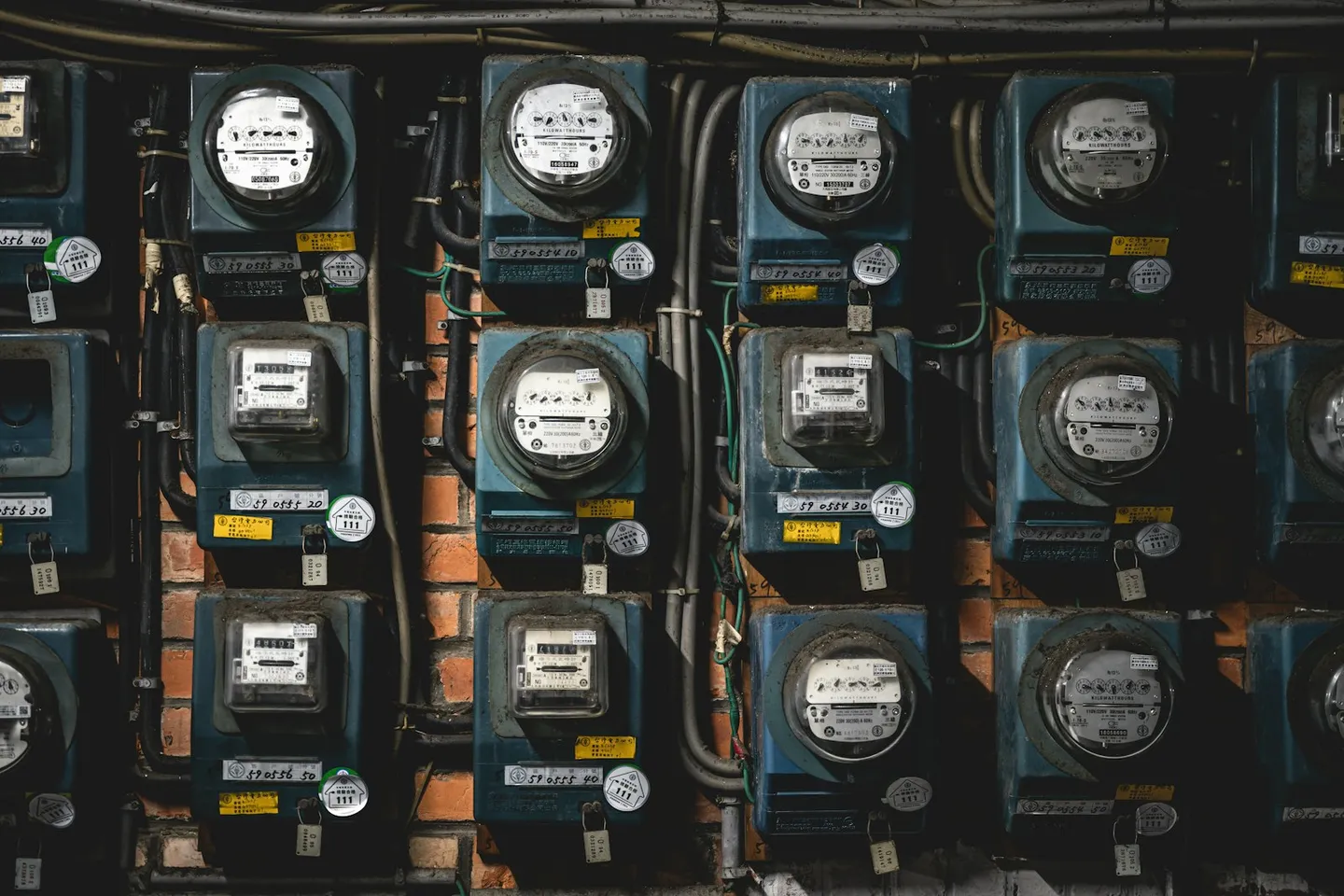
Photo: Stacked electrical meters on a commercial building's metering wall. Photo by Han-Hsing Tu on Unsplash.
"We already have a smart meter, so why do we need an energy management system?" It's a fair question, and it comes up in nearly every first call with a UK operator. The honest answer is that a meter and an EMS do two completely different jobs. The meter counts. It doesn't decide anything.
A business smart meter is a data collection device. It measures how much electricity (or gas) a building consumed in a given interval and reports that number somewhere, to a supplier for billing, to a data platform for analysis, or both. What it does not do is tell you why consumption jumped on Tuesday, whether that jump is a fault or just cold weather, or what to do about it. That gap, between having interval data and having something actionable, is exactly where an energy management system sits, and it's worth understanding precisely what a meter hands over before deciding what still needs to be built on top of it.
What business smart meters actually output: AMR, SMETS2, and half-hourly data
"Smart meter" gets used loosely, but commercial buildings in the UK are typically served by one of two distinct technologies, and the difference matters more than most guidance admits.
AMR (Automated Meter Reading) is the older, more common technology for larger commercial and industrial supplies. An AMR meter typically communicates one-way: it logs consumption and pushes readings to the supplier or a data collector on a schedule, commonly daily, without a live two-way link back to the customer. AMR remains the standard choice for Current Transformer (CT) metered sites and larger loads where SMETS2 hardware isn't suitable.
SMETS2 is the current UK smart meter specification, mostly associated with the domestic and small-business rollout. A SMETS2 meter communicates two-way over the dedicated Data Communications Company (DCC) network, which is what lets a household see live usage on an in-home display and keeps the meter "smart" even after switching supplier. For contrast: a residential SMETS2 meter and a commercial one run the same underlying specification, but a business account behind one typically feeds interval data into billing and, increasingly, into monitoring platforms rather than a home display.
Neither of those labels, AMR or SMETS2, actually tells you the interval the data is recorded at. That's a separate question, and it's the one that matters for anything analytical:
- Half-hourly (HH) data means consumption is metered and settled in 48 discrete 30-minute blocks per day. This is the interval that makes anomaly detection and load-shape analysis possible at all, because it's fine-grained enough to see a chiller cycling, a load ramping outside operating hours, or a step-change that a daily or monthly total would completely hide.
- Non-half-hourly (NHH) data means consumption is estimated between periodic actual reads, using an industry standard consumption profile rather than a real interval reading. NHH data can still support high-level benchmarking, but it cannot support the kind of pattern-of-use analysis that catches a fault while it's small.
The practical takeaway: the meter technology (AMR vs. SMETS2) and the settlement interval (HH vs. NHH) are two independent questions, and a building operator needs to know the answer to both before assuming their metering already supports proper monitoring and targeting (M&T).
MHHS and P272: how UK meter settlement got here, and where it's going
UK electricity settlement, the process that reconciles actual demand against what suppliers bought on the wholesale market, has been moving from estimated to measured consumption in stages for over a decade. Two reforms matter for a commercial building owner.
P272 was the first major step. This Balancing and Settlement Code modification required non-domestic customers in profile classes 5 to 8, broadly, larger businesses with maximum demand above 100kW, to move from estimated NHH settlement to actual half-hourly settlement. Ofgem approved P272 in October 2014, and after an extended rollout, suppliers were required to have compliant customers migrated by April 2017. If your building already sits in that larger-user band, it has been settled on half-hourly data for years; MHHS changes nothing for you.
MHHS (Market-wide Half-Hourly Settlement) is the market-wide extension of that same principle to everyone else, smaller businesses and households currently on NHH settlement. Sponsored by Ofgem and delivered by Elexon, MHHS migrates the remaining meters onto half-hourly settlement so the whole market, not just large non-domestic supplies, settles on actual consumption. The programme's timeline has moved before: supplier migrations began in October 2025 (pushed back from an original early-2025 start), the bulk of migrations are expected between May 2026 and May 2027, and the current final deadline for every supplier to have completed migration is 7 May 2027. Once the migration completes, the settlement cycle itself shortens, from roughly 14 months today to around 4 months, because settlement no longer has to wait on reconciling estimates against later actual reads.
What this means for a building owner with a smaller supply: you don't need to do anything to "get" MHHS, your supplier manages the migration, but once it lands, your meter (assuming it's a working smart or advanced meter) starts generating the same half-hourly interval data that larger buildings have had for years. That's a genuine step up in raw data granularity. It is not, on its own, a step up in insight.
What half-hourly data can and cannot feed an EMS
This is the part most metering guidance skips, because suppliers and meter operators are incentivized to stop the story at "you'll have half-hourly data." For an operator trying to actually run a building better, that's the beginning of the story, not the end.
What half-hourly meter data gives you: a clean, granular record of consumption, kWh (or equivalent) per 30-minute block, for every day the meter has been live. Fed into a data warehouse, that record is enough to plot a load profile, compare week over week, and spot the coarsest anomalies, a building running at full load overnight when it should be near zero, for instance.
What it does not give you is context, and context is what monitoring and targeting (M&T) actually runs on. Consumption alone can't tell you whether a spike is a fault or a cold snap; that needs weather data, typically degree days, regressed against consumption to separate weather-driven load from everything else. It can't tell you whether a weekend reading is expected or anomalous; that needs an occupancy or schedule baseline. And it can't tell you whether a shift in consumption pattern is actually costing more money; that needs the tariff structure layered back on top of the interval data, because half-hourly settlement exists precisely so charges can vary by time of use.
Statistical M&T methods like CUSUM (cumulative sum control charts, used to detect a sustained shift in a baseline rather than a single outlier) and degree-day regression both need that external context to work. They take half-hourly consumption as an input, not as the whole model. A meter that outputs perfect 30-minute intervals but nothing else still leaves someone building the weather baseline, the occupancy calendar, and the tariff model by hand, in a spreadsheet, before any of it becomes a finding rather than a chart. That loop is energy monitoring and targeting: half-hourly data is the input; CUSUM, degree-day regression and the rest of the M&T toolkit are what turn those intervals into findings someone can act on.
That's the gap FrostLogic Explore is built to close: it takes the interval data a business smart meter (or AMR device) already produces, lands it in the same data warehouse as BMS and sensor data, and layers weather, schedule and tariff context on top so a half-hourly spike becomes a ranked, explained finding, not a chart someone has to interpret by eye. The meter did its job the moment it recorded the interval. Turning that interval into a decision is a different job, and it's the one an energy management system is actually for.
FAQ
What is the difference between AMR and a smart meter? AMR (Automated Meter Reading) typically communicates one-way, pushing consumption reads to the supplier or a data collector on a schedule, and is the common choice for larger commercial and industrial supplies, including Current Transformer (CT) metered sites. A smart meter under the SMETS2 specification communicates two-way over the dedicated national network, which is what supports features like a live in-home display. Both can, depending on configuration, produce half-hourly interval data; the technology and the settlement interval are separate questions.
What is MHHS? MHHS (Market-wide Half-Hourly Settlement) is Ofgem's programme, delivered by Elexon, to move the remaining non-half-hourly electricity meters in Great Britain onto half-hourly settlement, extending the principle that P272 already applied to larger business meters in 2017. Supplier migrations began in October 2025, most meters are expected to move between May 2026 and May 2027, and the current final deadline for suppliers to complete migration is 7 May 2027.
Do I need a smart meter for automated demand response? You need a meter capable of half-hourly (or finer) interval reporting to participate meaningfully in most flexibility and demand response schemes, since payment is typically calculated against your actual interval consumption during an event window. A half-hourly-capable meter is a prerequisite for measurement, but it doesn't identify which loads can flex, size the opportunity, or manage the response itself, that operational layer sits above the meter.
Does half-hourly data automatically improve energy management? No. Half-hourly data is a higher-resolution input, not an analysis. Turning it into something actionable, catching a fault early, separating weather-driven consumption from a genuine anomaly, quantifying the cost of a pattern change, still requires weather, occupancy and tariff context layered on top, which is the job of monitoring and targeting tools and an energy management system, not the meter itself.
Will MHHS change my energy bills? MHHS changes how your consumption is measured and settled, not the underlying tariff you're on. Historically, businesses moved onto half-hourly settlement under P272 mostly saw bills stay flat or fall slightly as billing shifted from estimated to actual consumption, though outcomes varied by site and meter type. MHHS's direct effect is data granularity and a shorter settlement cycle; any bill impact depends on your supplier and tariff, not the settlement reform itself.
FrostLogic Explore brings sensor intelligence, scenario simulation, and grounded-inference AI to commercial and industrial buildings. Learn more about Sensor Intelligence or talk it through with us.
Curious how this would look on your building?
What's your building not telling you?
Twelve questions about your building. About two minutes. Free. You get a Building Intelligence Score. No pitch.