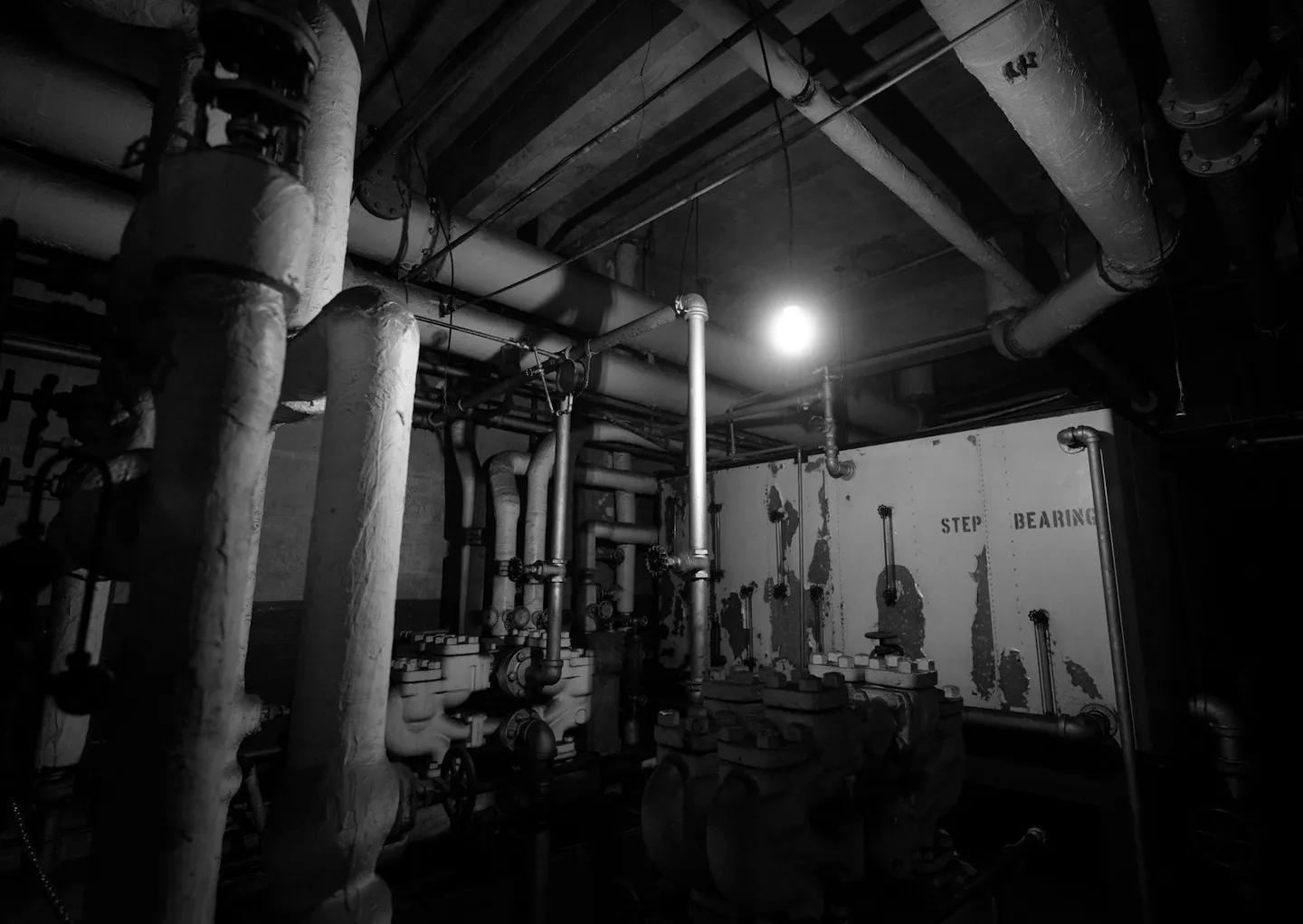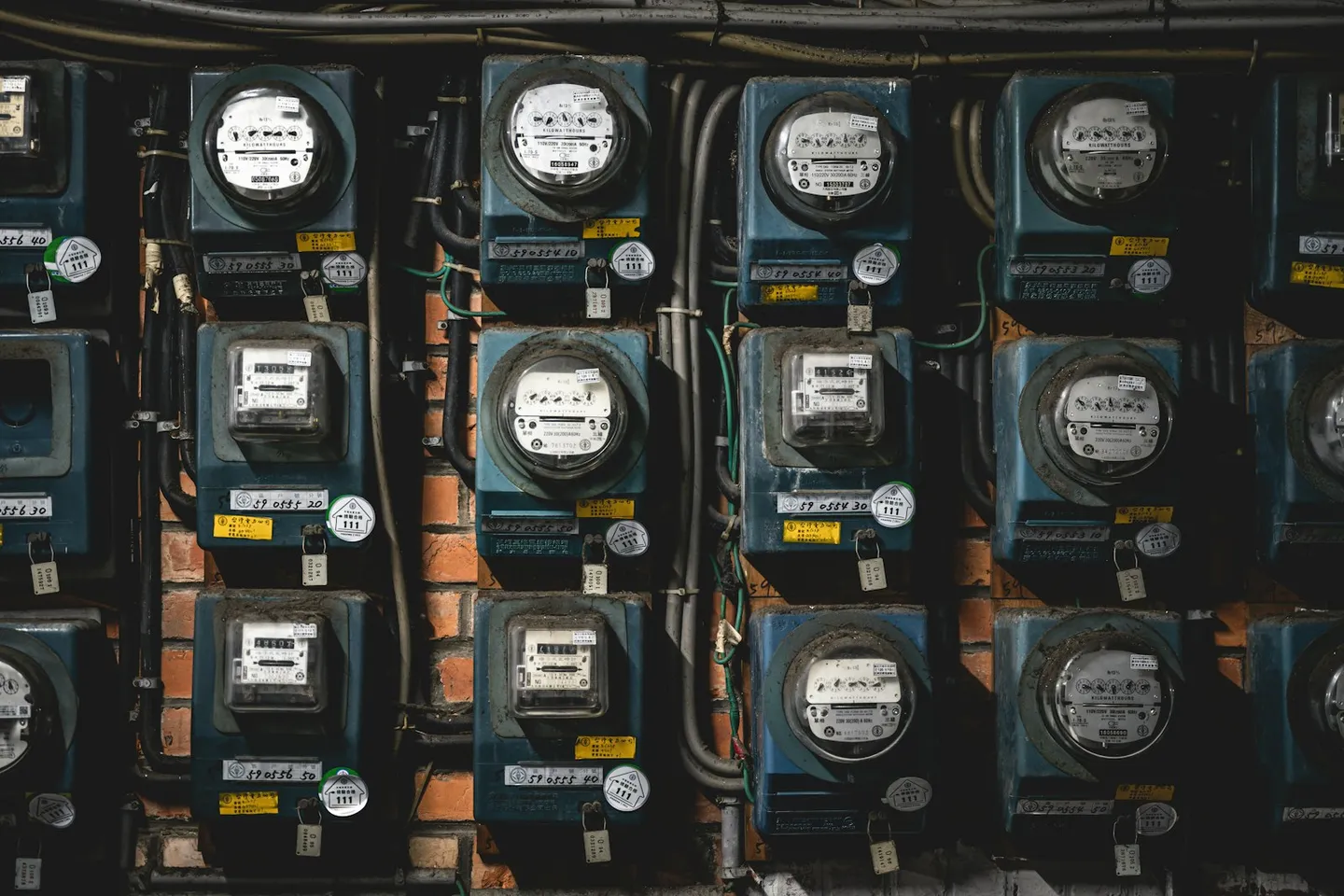
Photo: Stacked electrical meters on a commercial building. Photo by Han-Hsing Tu on Unsplash.
A spreadsheet that says “we saved 12%” is not a saving. It is a claim. Until you name a baseline, a reporting period and a measurement boundary, that number is still a guess dressed as certainty.
IPMVP (International Performance Measurement and Verification Protocol) is the framework operators, ESCOs and incentive schemes use when they need the claim to survive scrutiny. The current edition is IPMVP Core Concepts 2022, maintained by Efficiency Valuation Organization (EVO). This article is the operator cut: what the Options mean on a real estate, what a baseline actually is, and why an estimate fails audits even when the retrofit looks fine on a slide.
FrostLogic Explore is not an IPMVP auditor, not an EVO certification product, and not a CAE or white-certificate issuer. It is Sensor Intelligence that measures operational change against weather-aware baselines. The honesty of that loop is compatible with IPMVP thinking. Compatibility is not certification.
What IPMVP is (and what savings actually are)
EVO’s core point is blunt: savings are the absence of energy. You cannot put a meter on “savings.” You measure use before and after a project, inside a defined measurement boundary, then apply documented adjustments so the comparison is fair.
That is measurement and verification (M&V). Operational verification (the measure was installed and runs) is good practice. It is not a substitute for measured savings. A signed commissioning sheet that says the chiller is online does not prove the building uses less energy than it would have without the project.
IPMVP is a flexible framework, not a single calculator. An M&V Plan records the Option chosen, the boundary, the baseline period, the reporting period, the adjustments you will make, and how savings will be reported. If those pieces are missing, you do not have an IPMVP-grade answer. You have a narrative.
Options A–D: pick the meter boundary first
The four Options are not a ladder of “better” to “worse.” They are different answers to where you draw the boundary and what you insist on measuring.
| Option | Boundary idea | What you meter | When operators actually pick it |
|---|---|---|---|
| A | Retrofit isolation | Key parameter(s) measured; other factors estimated | Lighting retrofit with hours-of-use sampled; one critical variable dominates |
| B | Retrofit isolation | All relevant parameters measured | Isolated plant upgrade where you can meter every driver that moves the result |
| C | Whole facility | Utility or whole-building meters | Portfolio programmes, controls changes that bleed across systems, ESCO deals billed on the main meter |
| D | Calibrated simulation | Model calibrated to whatever reliable data exists | New construction, missing or broken baseline history, major renovations that erase the old pattern |
Option A keeps cost down by measuring what matters most and estimating the rest. The trade-off is honesty: every estimated factor is a place the number can be argued. Use A when the key parameter really is key, and when you can defend the estimates.
Option B still isolates the retrofit, but measures all parameters that drive energy inside that boundary. Prefer B when submeters and sensors already sit on the right circuits and you refuse to invent the rest.
Option C steps up to the whole facility. Utility bills or building-level interval meters become the evidence. That fits when interactions across plant make isolation messy, or when the contract pays on the main meter. Noise goes up: occupancy, weather and unrelated loads all sit in the same series. The M&V Plan has to say how you will handle that.
Option D uses a calibrated simulation when baseline or reporting data are unreliable or unavailable. New buildings are the textbook case. Simulation is not a free pass to invent savings; the model has to be calibrated against measured data you do have, and the Plan has to say how.
Choose the Option from the meter reality you can defend, not from the Option that produces the largest brochure percentage.
Baselines, reporting periods and adjustments
A baseline is the measured energy use (and relevant conditions) for a defined period before the project, inside the measurement boundary. A pretty annual average from three utility bills is usually not enough for serious M&V. You need a period long enough to cover operating modes that matter, with enough context that “before” means something.
The reporting period is the measured use after the project, for the same boundary. Savings are not “this month versus last month.” They are reporting-period use compared with what the baseline would have been under reporting-period conditions.
That last clause is where adjustments live.
Routine adjustments cover expected drivers that always move: weather, occupancy patterns, production volume, operating hours. Degree days are the common weather covariate for heating and cooling loads. A regression of the form kWh ≈ a + b·HDD + c·CDD (often with a weekend or occupancy flag) is how many teams turn “it was cold” into a fair comparison.
Non-routine adjustments cover one-off changes that break the old relationship: a new wing, a changed tenant density, a plant replacement unrelated to the EEM, a schedule policy rewrite. If you ignore them, you either invent savings or hide regressions. Document them in the Plan; do not invent them after the audit starts.
Energy monitoring and targeting is the continuous operating method that keeps those baselines alive between projects. IPMVP is the protocol language for proving a discrete saving. The two complement each other; they do not compete for the same keyword.
Why estimates fail audits, incentives and ESCO deals
Estimates fail for boring reasons.
The boundary was never written down, so the “saving” mixes LED, envelope and a BMS schedule change into one story nobody can re-measure. The baseline was reconstructed after the retrofit, so the before-curve is fiction. Weather was ignored, so a mild winter looks like brilliance. Hours of use were taken from a manufacturer datasheet instead of the building. Operational verification stopped at “equipment installed,” and nobody checked whether the saving held at month six.
Incentive schemes, utility programmes and performance contracts care about those failure modes because they pay on verified energy, not on CAPEX theatre. In Spain, CAE (certificados de ahorro energético) live or die on measured verification; that market has its own Field Note in Spanish. Elsewhere the paperwork differs. The operator lesson does not: if you cannot defend the baseline and the boundary, you do not have a saving.
BREEAM and similar schemes may ask for energy evidence. That is not a licence to paste an estimated percentage into a credit narrative and call it M&V. Explore does not issue BREEAM certificates either; continuous measured evidence simply makes the conversation shorter.
How Explore’s Energy Savings Loop stays honest
FrostLogic Explore is Sensor Intelligence for commercial and industrial estates. It reads the meters, BMS and sensors you already run, ranks waste in a queue, and tracks whether approved changes held. It is not a CMMS, not an ESCO, and not an IPMVP auditor.
The product bridge that matches this article is the Energy Savings Loop. Nightly waste findings feed approved
changes. Outcomes are measured at 7, 14 and 28 days against a weather-normalised baseline of the form
kWh ~ a + b·HDD + c·CDD + d·weekend. Verdicts are saving / no_effect / regression / inconclusive. There is no
“estimated” savings tier. Money appears only when the customer set a tariff. A null result is not zero; inconclusive
means the data do not yet support a call.
Smart Schedules can use switchback measurement where that design is available in pilot. Do not treat switchback as standard on every estate. Writes start off; scopes are granted when you want write-back.
The commercial path for continuous meter reads is energy management software. The discipline of proving a saving still belongs to IPMVP and to your M&V Plan. Explore’s job is to keep the measured loop running so the Plan is not a once-a-year PDF.
FAQ
What is IPMVP? IPMVP is the International Performance Measurement and Verification Protocol maintained by EVO. The current edition is IPMVP Core Concepts 2022. It is a framework for measuring and verifying energy (and related) savings when you cannot meter “savings” directly.
What is measurement and verification? Measurement and verification (M&V) is the practice of quantifying savings by comparing measured use before and after a project, inside a defined boundary, with documented adjustments. Operational checks that equipment works are necessary; they are not M&V on their own.
What is IPMVP Option A? Option A is retrofit isolation with key parameter(s) measured and other factors estimated. Use it when one or a few variables dominate and you can defend the estimates.
What is IPMVP Option B? Option B is retrofit isolation with all relevant parameters measured. Prefer it when you can meter every driver that moves the isolated result.
What is IPMVP Option C? Option C is whole-facility M&V using utility or whole-building meters. It fits programmes and contracts that settle on the main meter, at the cost of more noise from unrelated loads.
What is IPMVP Option D? Option D uses a calibrated simulation when baseline or reporting data are unreliable or unavailable, such as new construction. The model still needs calibration against measured data.
Is a spreadsheet estimate an IPMVP saving? No. An estimate without a documented Option, boundary, baseline, reporting period and adjustments is a claim, not a verified saving. IPMVP exists so those pieces are explicit.
Does FrostLogic Explore implement IPMVP or certify savings? No. Explore does not hold an IPMVP certification, is not an EVO certification product, and is not an auditor. Its Energy Savings Loop measures approved changes at 7, 14 and 28 days against a weather-normalised baseline with no estimated-savings tier. That operational honesty aligns with measured baselines; it does not replace a formal M&V Plan or third-party verification where a contract requires one.
What's your building not telling you?
If your “savings” still live in a slide deck, bring the meters you already have. We listen first, then say straight whether Explore’s measured loop helps on your estate. 30 or 60 minutes, your pick. No commitment either way. Talk it through.
FrostLogic Explore brings sensor intelligence, scenario simulation, and grounded-inference AI to commercial and industrial buildings. Learn more about Sensor Intelligence or talk it through with us.
Curious how this would look on your building?
What's your building not telling you?
Twelve questions about your building. About two minutes. Free. You get a Building Intelligence Score. No pitch.