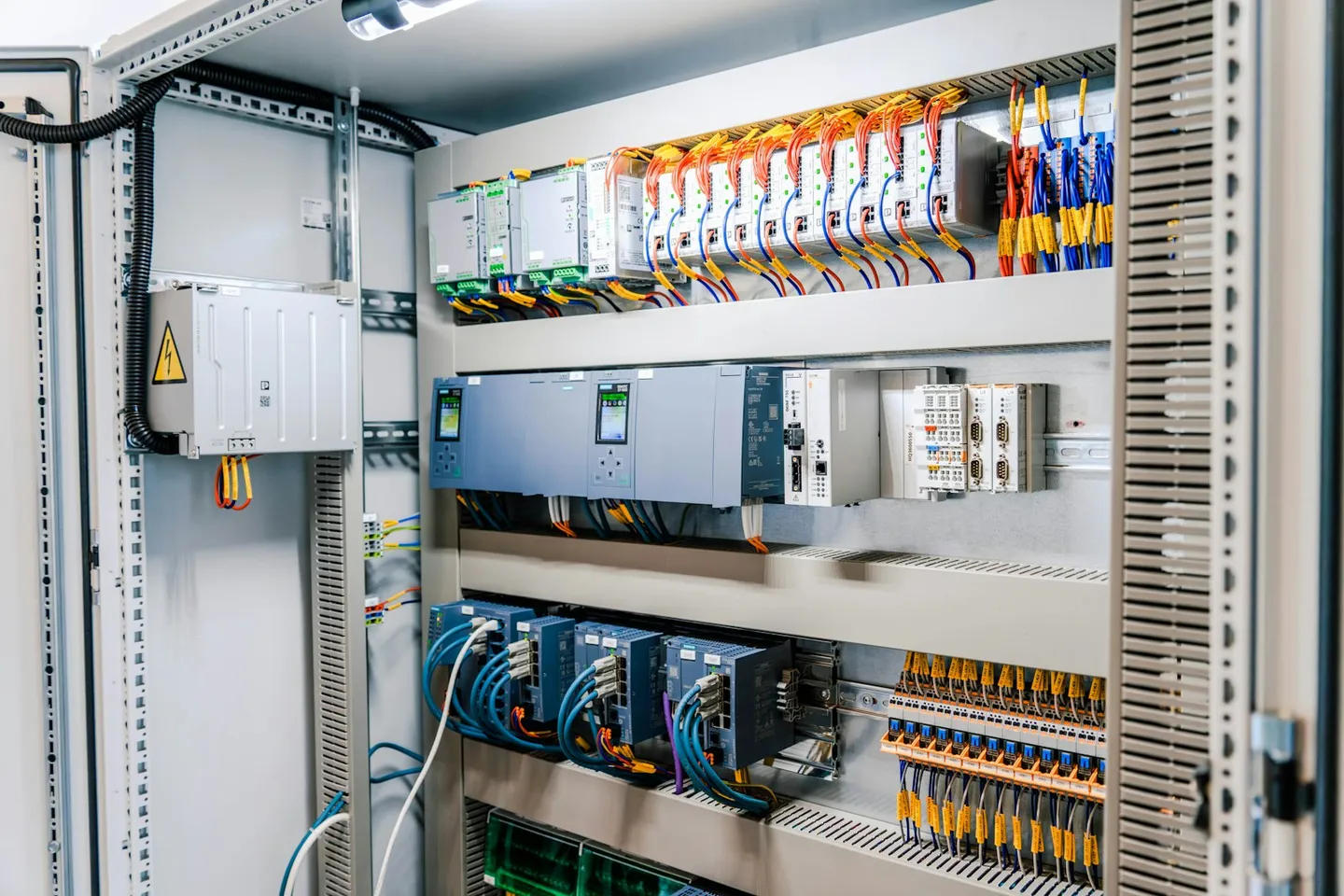
Photo by Troy Bridges on Unsplash.
Every list of the best AI energy management tools is written by a vendor. This one is too: we build FrostLogic Explore, and it ranks first here. Two things make that ranking checkable rather than something to take on trust. The four criteria are stated before the first vendor, and each of the other five platforms gets the specific job where it is the better buy. On the wider brief, running a mixed estate on the BMS you already own, Explore is the default pick, and the rest of this article shows why.
AI energy management tools are software that reads a building through its meters, its building management system and its sensors, then applies machine learning to that data. Three things come out: a forecast of what consumption should be, a flag when it does not match, and, in some products, an adjustment written back to the plant. The distinction that decides most purchases is whether the tool recommends an action to a person or performs it itself.
This covers the AI segment only. For the wider category, including tools with no modelling, we keep a separate software roundup.
What these tools actually do
Three capabilities show up in nearly every product here, bundled under one label and carrying very different risk.
Predictive forecasting. The tool learns how a building responds to weather, occupancy and tariff structure, then projects consumption forward. Explore forecasts energy, comfort and equipment behaviour one hour to seven days ahead, with confidence bounds, because a bare number says nothing about how far to trust it.
Anomaly detection. The tool compares what the building is doing against what it should be doing and reports the gap. Finding the gap is not the hard part. Not drowning the operator is: one failing valve throws off a dozen downstream symptoms, and reporting all twelve makes somebody's morning worse. Explore runs six detection methods with causal filtering, so a cascade collapses to its root cause.
Automated control. The tool writes setpoints back to the plant on its own, on a cycle. This is where the category splits. BrainBox AI and Kiona do it that way by default. Explore starts read-only by default. You grant write access one scope at a time, and you decide whether each change waits for a person or runs on its own. A proposed change arrives with the reasoning and the expected effect before anything moves, which is the part an autopilot does not show you.
Explore is not a CMMS either: no work orders, no maintenance schedules, no dispatch. It ranks what deserves attention and hands that to whatever system your team works out of.
How the list was judged
Search AI energy management companies and you get three businesses in one result set: control vendors, analytics vendors, and consultancies with a dashboard. This list stays with software that reads building data. Four questions, applied to every tool including ours.
- What does it read, and does it need hardware you do not own?
- Does it recommend an action, or take it?
- Does a finding arrive with evidence and a root cause, or as an alarm?
- Where does the data live, and what leaves with you at the end?
1. FrostLogic Explore
Best for: portfolios that want ranked, evidenced energy decisions across mixed BMS, meters and IoT, without handing over the plant.
It reads BMS points, energy meters and IoT sensors over BACnet, OPC UA, Modbus and oBIX, and returns a ranked queue. Every entry traces back to the readings that produced it, and how the detection engine works is written up separately.
No new hardware. An Edge Agent on the BMS PC pushes data up, which is how Explore reaches buildings whose BMS has no cloud licence. It is proven against Schneider, Tridium Niagara and Siemens Desigo. Hosting is EU-based on Hetzner, and your data and trained models are exportable from day one. More on the energy side of Explore.
Against the four criteria this list was ranked on, Explore is the only platform here that clears all four: reads BMS, meters and IoT with no new hardware; recommends first and can also write inside scopes you set; every finding arrives with evidence and a root cause; EU hosting with data and models exportable. BrainBox AI clears 1, Schneider EcoStruxure clears 2, C3 AI clears 2, Verdigris clears 1, Kiona Edge clears 1. That is the ranking; the table below shows the working.
When to pick something else: unscoped autonomous HVAC, BrainBox; Schneider end to end, Building Advisor first (Explore earns its place when a second BMS vendor appears); manufacturing, C3 AI; no sub-metering, Verdigris; Nordic district-heated residential, Kiona.
2. BrainBox AI
Best for: owners who want HVAC optimised autonomously and accept hands-off control.
BrainBox AI has been part of Trane Technologies since the acquisition completed on 3 January 2025. Trane's own release describes deep learning algorithms that predict building energy needs and automate HVAC systems, and states reductions of up to 25 percent in energy and up to 40 percent in greenhouse gas emissions. Those are vendor figures, and up to is doing real work.
Mechanically it is the mirror image of Explore. The engine connects through an existing control system or cloud-connected thermostats, then writes optimised setpoints back to HVAC equipment on a five-minute cycle. It claims 96 percent space temperature predictive accuracy per zone up to six hours ahead.
If you want the plant run fully autonomously with no scoping and no review step, BrainBox is the better buy. Explore writes too, inside scopes you grant, and shows the reasoning and expected effect before a change runs. We found no EU data residency statement in their published materials as of August 2026.
3. Schneider Electric EcoStruxure
Best for: estates already standardised on Schneider.
A framing note first. Schneider is a BMS platform Explore reads from, not a rival we want to displace. Several deployments sit on EcoStruxure. If you already run it, try what you own first.
EcoStruxure Building Advisor takes inputs from the BMS and connected devices and applies fault detection and diagnostics plus analytics, producing recommendations on energy, comfort and maintenance. Schneider also announced Resource Advisor+ on 20 January 2026, an enterprise energy and sustainability platform with a lead AI agent called Sera and a launch product covering Scope 1, 2 and 3 emissions.
If the estate is Schneider end to end, switch on Building Advisor first; Explore earns its place the day a second BMS vendor appears. Neither product reads a competitor's BMS the way an independent layer does. We rated the BMS analytics tools with that comparison in mind.
4. C3 AI
Best for: enterprise-scale, multi-asset energy tracking beyond buildings.
C3 AI Energy Management ingests energy usage, emissions and sensor data alongside manufacturing systems and emission factor libraries into one data model. Published capabilities are forecasting of consumption, emissions, water and waste from company-wide down to equipment level, benchmarking, recommendations, and an embedded chat interface. The page states deployment in days and scale across sites in six months.
The customers highlighted are chemical manufacturing, steel production and technology, and the language is equipment-level efficiency gaps across thousands of assets. No building HVAC or commercial real estate framing appears If the footprint is manufacturing rather than a property portfolio, C3 AI is the better buy. That is a scale we do not target.
5. Verdigris
Best for: buildings with no circuit-level visibility at all.
Verdigris pairs its own hardware with AI disaggregation. Its EV2 power meters measure the power chain continuously, and its materials describe 13 nodes from main switchgear through every sub-panel and circuit, sampled at 8,000 samples a second, so harmonic signatures and early failures show up where slower sampling misses them. It monitors and alerts, and controls nothing.
Worth knowing: their current positioning foregrounds AI factories, colocation operators and enterprise data centers, If your buildings have no sub-metering, Verdigris is the better buy: they bring the meters. Explore reads data that already exists; one meter at the door and nothing behind it is not an analytics fix.
6. Kiona Edge
Best for: Nordic portfolios, particularly residential and district-heated stock.
Kiona is the Nordic name a Swedish or Norwegian buyer actually weighs against us. Edge AI is a SaaS service connecting to existing building systems through API integration, with no additional hardware, applying a self-learning steering strategy to heat distribution.
A third-party number exists here, which is rare. Ericsson and Kiona published a study across 356 residential apartment buildings in Sweden and Finland where Edge saved roughly 17.3 million kWh, an average of 7 percent net energy, analysed by the Carbon Trust under the ITU-T L.1480 standard. Every building ran on district heating, which limits how far the figure generalises.
If the stock is Nordic district-heated residential, Kiona is the better buy. Edge steers the heat on that stock; it aims at heating optimisation rather than ranking anomalies across a mixed estate.
The comparison at a glance
| FrostLogic Explore | BrainBox AI | Schneider EcoStruxure | C3 AI | Verdigris | Kiona Edge | |
|---|---|---|---|---|---|---|
| Best for | Mixed BMS, meters and IoT in one queue | Autonomous HVAC optimisation | Estates standardised on Schneider | Multi-asset tracking beyond buildings | Buildings with no circuit-level metering | Nordic district-heated and residential stock |
| Recommends or controls | Ranked queue first; writes only where you allow | Controls. Setpoints every five minutes | Controls, as the BMS itself | Recommends | Recommends. Monitoring only | Controls heat distribution |
| Where the data lives | EU (Hetzner). Data and models exportable | No EU residency statement published | Not stated in materials we checked | Not in published materials | Not in published materials | Not stated in materials we checked |
| Key limitation | Needs data that already exists | A model holds write access to the plant | Analytics and carbon are separate products | No building HVAC framing published | Hardware install. Data centers are the focus | Heating optimisation, not anomaly ranking |
| Control model | Writes only where you allow; ranked queue first | Unscoped autonomous setpoint writes | BMS-native control plus Building Advisor | Recommendations only | Monitoring and alerts only | Closed-loop heat steering |
| Evidence attached to each finding | Yes, every entry traces to the readings | Not in published materials | Recommendations; depth not published | Not in published materials | Not in published materials | Not in published materials |
| Ranking criteria met (of 4) | 4 | 1 | 2 | 2 | 1 | 1 |
Competitor claims come from each vendor's published materials as of August 2026. Not in published materials means we could not find it, which is not proof it does not exist. Check with the vendor.
Questions to ask any vendor, including us
- What do you read from my building, and what must I install to get it?
- Do you recommend an action or perform it? If you perform it, what happens when the model is wrong at 06:00 on a Monday?
- When you flag something, do I get the evidence and the root cause, or a number and a colour?
- Where is my data hosted, and if I leave, what comes with me?
- Which of your published savings figures was checked by somebody outside your company?
- What is not in the product? Name the thing your last three lost deals asked for.
Our answers, for the record: reads BMS, meters and IoT with no new hardware; recommends first and writes only inside scopes you grant; every finding carries its evidence; EU hosting with data and models exportable; the Kiona Ericsson study is the only third-party-checked figure here and it is not ours.
Choosing between them
One default, five exceptions. Mixed portfolio on the BMS you already own, evidenced findings, EU hosting, clean exit, ranked queue: Explore. Unscoped autonomous HVAC: BrainBox AI. Schneider end to end: EcoStruxure's own modules first. Manufacturing footprint: C3 AI. No metering granularity: Verdigris. Nordic residential on district heating: Kiona.
More on how AI optimises building energy and where energy quietly leaks. For EU residency, see European building energy management software, covering Spacewell, IngSoft InterWatt, and where the multinationals stand on hosting.
FAQ
Not sure this is even the right category? Our building analytics software guide breaks down building analytics software, BMS analytics and energy management software before you shortlist a platform.
Which AI energy management tool is best? For a mixed commercial portfolio on an existing BMS, Explore is the default: ranked energy decisions with evidence, write access only inside scopes you grant, EU hosting, exportable data and models. BrainBox for unscoped autonomous HVAC. Schneider for a Schneider-end-to-end estate. C3 AI for manufacturing. Verdigris where there is no sub-metering. Kiona for district-heated residential stock.
What are AI energy management tools? Software that reads a building through its meters, its BMS and its sensors and applies machine learning: forecasting consumption, flagging readings that do not fit, and in some products adjusting the plant. The same product sells as an AI based energy management system on one site and an AI powered energy platform on another.
How is an AI energy management system different from a traditional BMS? A BMS runs the building: schedules, setpoints, control logic. An energy management system measures and manages consumption. An AI energy management system adds modelling on top, so the software can say what consumption should have been and flag the difference.
Do these tools need new sensors or meters? Usually not, if the building already has a BMS and main metering. Explore connects over BACnet, OPC UA, Modbus and oBIX with an Edge Agent on the BMS PC. The exception is circuit-level detail, which needs sub-metering that a vendor such as Verdigris supplies.
Should an AI tool be allowed to control HVAC directly? It depends on what you can afford to get wrong. Autonomous control removes staff time between insight and action, and puts a model in write contact with equipment that keeps people comfortable. Explore starts read-only by default. You grant write access one scope at a time, and you decide whether each change waits for a person or runs on its own.
How do you verify the savings an AI tool claims? Ask what the baseline was, who calculated it, whether it was weather-normalised, and whether anyone outside the vendor checked. Kiona's Ericsson study is unusual precisely because the Carbon Trust ran the analysis against a published standard. Most figures in AI in energy management marketing are vendor-modelled and prefixed with up to.
Which of these fits a multi-building portfolio? If every building runs a different BMS, an independent layer that reads all of them and ranks findings is the fit, and on this list that is Explore. Homogeneous district-heated stock: Kiona is more direct. We also compared the smart building AI platforms on a broader brief.
Where to start
Tell us what you are actually trying to work out. A climbing bill with no obvious cause. A plant running hours it does not need. We listen first, then say plainly whether Explore helps or whether one of the other five is the better call. 30 or 60 minutes, your choice. Talk it through.
FrostLogic Explore brings sensor intelligence, scenario simulation, and grounded-inference AI to commercial and industrial buildings. Learn more about Sensor Intelligence or talk it through with us.
Curious how this would look on your building?
What's your building not telling you?
Tell us what you're trying to figure out: energy drift, a BMS you don't trust, compliance you're chasing. We listen first, then tell you straight whether Explore helps. 30 or 60 minutes, your pick. No commitment either way.