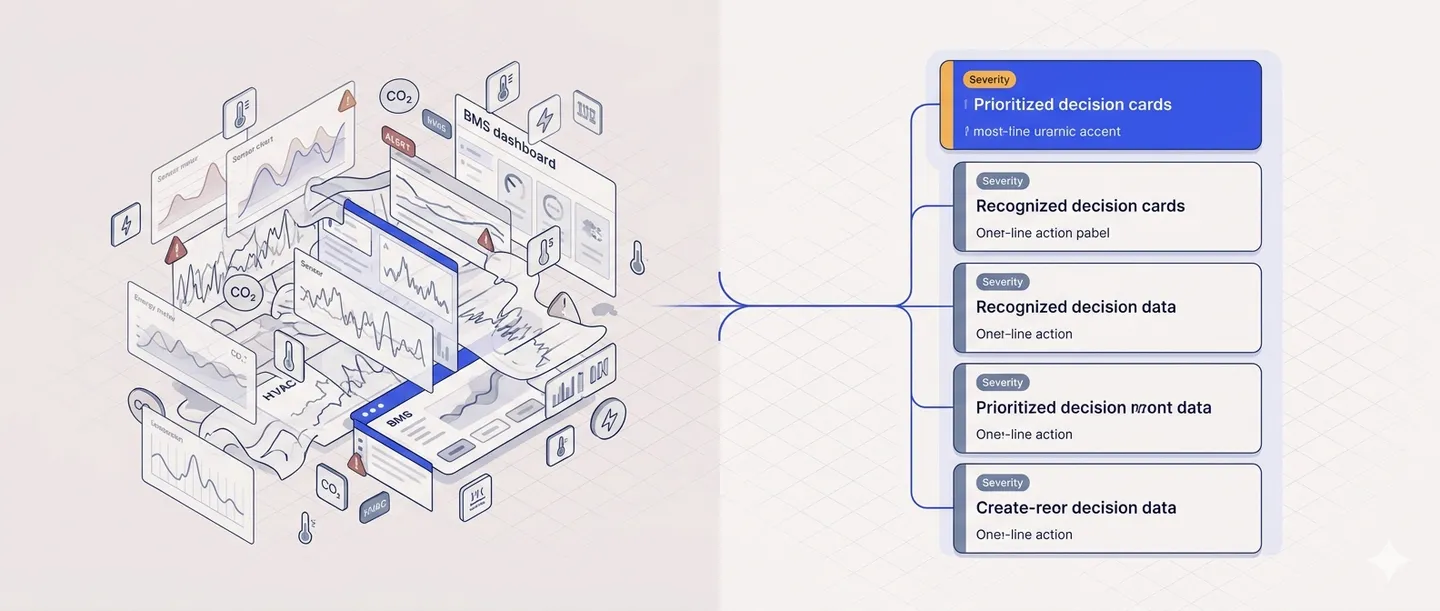
Three things happened in the last eighteen months that changed the smart building software market for buyers. The category got crowded. The vocabulary got vague. And the regulatory deadline finally landed on the calendar.
If you sit in facilities, sustainability, or asset management of a commercial portfolio, you are now being pitched “AI” by almost every vendor in the building stack. Some of it is real. A lot of it is a chatbot bolted to a BMS dashboard and rebadged. Telling them apart is harder than it should be, because the marketing language has converged faster than the underlying technology has.
This guide is for the buyer trying to do that work. It covers what smart building AI actually is in 2026, the five capabilities worth paying for, the architectural camps the market has settled into, the questions that separate a real platform from a wrapper, and the regulatory context Nordic operators are buying into. It is written by a team that ships one of these platforms, so the bias is disclosed up front. Where we hold an opinion, we say so. Where the honest answer is “it depends on your building,” we say that too.
What is smart building AI?
Smart building AI is software that reads continuously from the sensors and meters already installed in a building, learns the patterns in that data, and produces decisions, predictions, or alerts that an operator can act on without re-doing the analysis themselves.
That definition is narrower than the marketing. It excludes three things people often call AI:
A rule-based BMS schedule that turns ventilation off at 6 PM is not AI. It is a schedule.
A dashboard that visualises live sensor data with colour-coded thresholds is not AI. It is a dashboard with thresholds.
A generic LLM chat window that summarises a building report is not, by itself, smart building AI. It is a chat window. The intelligence has to be in the system that reads the building, not just the system that talks about it.
Real smart building AI does three jobs that traditional building software cannot. It detects deviations from normal that no human is monitoring full-time. It predicts where the building is heading rather than only reporting where it has been. And it links a signal in the data to a recommended action, so the operator’s role shifts from reading screens to confirming or overriding suggested decisions.
The market reflects how recent the category is. Johnson Controls’ 2026 AI and Digitalization in Facilities Management report flags predictive maintenance as the top planned AI investment for FM teams this year, and global spend on AI in facility management is on track to pass twelve billion dollars in 2026, growing over thirty percent annually. That growth is happening because the underlying technology finally works on building data, and because the cost of not having it has stopped being abstract.
A useful operating definition for the rest of this guide: smart building AI is the layer between your sensors and your decisions. If a product does not directly improve the quality, speed, or volume of decisions your team makes, calling it AI is mostly cosmetic.
The five capabilities that matter
Not every smart building AI product does all of these. The ones worth a procurement cycle do most of them, and the very good ones do all five well.
1. Anomaly detection
A modern building produces somewhere between five thousand and fifty thousand sensor data points per hour. No human is reading that. The first job of a smart building AI platform is anomaly detection that finds the readings that matter and surfaces them in a way an operator can triage in minutes.
A useful anomaly detection layer does not just fire alarms when a value crosses a threshold. Threshold alarms are what your BMS already does, and they are why operators learn to mute the buzzer inside a few weeks. The bar is higher: the platform has to recognise drift that is still within range, frozen sensors reporting the last good value forever, equipment runtimes that have started to climb, two sensors that physics says must move together but no longer do, and the kind of subtle cross-signal incoherence that hides the most expensive faults.
The platforms doing this well combine several detection methods in parallel: statistical baselines for the obvious cases, physics-based checks against thermodynamic constraints, causal filtering to separate the root cause from its downstream echoes, and learned site-specific baselines that adapt as the building changes. No single method catches everything, and any platform that claims one technique solves the problem has not spent enough time in real buildings.
For a deeper walk through the data-trust side of this, the piece on AI and sensor validation covers what goes wrong when the inputs themselves are unreliable.
2. Forecasting
Monitoring tells you what just happened. Forecasting tells you what is about to. The shift matters because most operational costs (peak energy charges, comfort complaints, equipment failures, certification breaches) are cheaper to prevent than to remediate, and prevention requires knowing what is coming.
What separates a useful forecast from a number on a screen is the confidence band. A single-line prediction (“energy demand at 3 PM will be 412 kW”) is rarely actionable. A bounded one (“energy demand at 3 PM will be 395 to 430 kW with 90% confidence”) tells the operator how much margin to plan for. When the band is narrow the forecast can drive a tight schedule; when it is wide the operator knows to keep margin and check the inputs.
Good platforms run forecasts at multiple horizons (an hour, a day, a week, a season), share information across those horizons, and surface their own uncertainty honestly. The article on sensor forecasting goes into the mechanics in more depth.
3. Compliance automation
For any building targeting BREEAM In-Use, LEED, Nordic Swan, or other certification frameworks, compliance is moving from an annual exercise to a continuous one. Both the frameworks themselves and the regulations around them have been adding weight to continuous-evidence requirements in the last two recertification cycles, and the gap between annual-snapshot evidence and live-data evidence keeps widening.
A platform that automates compliance does three things: it maps each certification criterion to specific sensors (or sensor combinations), it watches those sensors against the thresholds continuously, and it produces an export at audit time that is a download rather than a six-week scramble. The compliance tracking deep-dive covers how this works in practice for the three major frameworks.
4. What-if simulation
A forecast tells you what will happen if conditions follow the expected path. A what-if simulation tells you what would happen if you changed something. Those are different questions, and they require different machinery.
The honest version of what-if simulation runs on a causal model, not a correlation. Asking “what happens if we raise the cooling setpoint by 1°C during occupied hours” is asking the platform to predict an outcome under conditions the building has not been operating under. A correlation-only model has nothing to base that on. A causal model encodes how the building actually responds (setpoint change reduces compressor runtime, lower runtime drops electricity demand, lower demand interacts with peak pricing, the total feeds back into cost) and can extrapolate to a configuration that has not happened yet.
This matters most for decisions that cannot be tested live. Lowering a setpoint to see what happens is fine in a lab. In a building with tenants, it is a customer-experience risk.
5. Grounded AI reasoning
The fifth capability is the newest, and the one with the widest quality gap between vendors. It lets an operator ask the platform a question in plain language (“why did energy use jump on Tuesday at 14:00 in zone B?”) and get an answer that cites the actual sensors and time ranges it came from.
The reason this matters: generic LLMs hallucinate. Benchmarks from 2025 and 2026 put ungrounded-LLM hallucination rates somewhere between 59 and 82 percent in domain-specific tasks. Systems with grounded inference, where the model can only answer from a verified data source and is forced to cite it, sit at one to two percent. The difference is the difference between an assistant and a confident liar.
For building operations, the only acceptable version is the grounded one. If the platform’s chat interface invents a setpoint history that does not exist, or cites a sensor that has been offline for three weeks, the operator who acts on that answer is worse off than the one who never asked.
Types of smart building AI platforms
The market has converged on three architectural camps. Each one is a reasonable choice for a different kind of buyer.
Hardware-first platforms. Built around the sensors the vendor sells, or a tightly integrated IoT stack. Sensative is a representative example in the Nordic market. Strong when the building is greenfield, when there is no existing sensor base to work around, or when the buyer values a single throat to choke for both the device layer and the software layer. Weaker when the building already has a comprehensive BMS, because the value of swapping the hardware to fit the software is rarely there.
Software-first platforms focused on energy optimisation. Egain in the residential portfolio space is a Swedish-rooted example; the large BMS vendors (Schneider Electric’s EcoStruxure Building Operation, Honeywell Forge, Siemens, Johnson Controls) sit broadly in this camp at the enterprise scale. They retrofit on top of existing BMS systems and concentrate on energy outcomes: tariff optimisation, fault detection on HVAC plant, benchmarking. Strong when the operator has a specific energy-saving mandate and a large portfolio. Trade-off: the dashboard footprint is often heavy, and the analytical scope tends to stop at energy. Broadening past that is what purpose-built energy management for commercial buildings sets out to do.
Decision-first platforms. A newer category. The output is a ranked queue of actions the operator should take, not a wall of charts. FrostLogic Explore sits here. Strong when the operator is already overloaded with alerts, when the building portfolio is larger than the team can monitor in real time, or when the buyer is specifically trying to move from reactive to predictive operations. Trade-off: the value depends on the team being willing to act on the queue. A platform that produces excellent decisions for an operator who keeps using their old workflow does not pay off.
The choice between these is not really technical. It is operational. If your bottleneck is hardware coverage, hardware-first wins. If your bottleneck is energy cost on a stable portfolio, energy-first wins. If your bottleneck is the number of decisions per day your team can make, decision-first wins.
What to evaluate when choosing a platform
Five questions, in roughly decreasing order of importance. If you would rather start from a side-by-side, our roundup can help you compare the leading platforms on criteria like these.
Can it actually read your existing BMS? Most platforms claim broad protocol support. Fewer demonstrate it on the specific BMS vendor, version, and configuration in your buildings. Ask for a connector list, the protocols supported in production (not on the roadmap), and a named customer running the same BMS family. BACnet, Modbus, and OPC UA are table stakes; modern API integration with the major cloud BMS products is increasingly expected. The right answer to “can you read my Niagara station running these tags” is a confident yes with a reference, not a slide deck. (For a worked view of what BMS coverage looks like on a real platform, the BMS analytics page lists the vendors and protocols Explore reads from.)
Is the AI grounded, or is it a generic LLM in a wrapper? Ask what data sources the system can answer from. Ask what happens when a required sensor is offline, drifted, or missing. A grounded system will tell you it cannot answer, or it will widen the uncertainty band on its forecast. A wrapper around a generic model will invent something plausible. The hallucination rates above are not theoretical; they are what shipped products do.
Where does the data live, and on whose terms? Two things to separate here. Hosting (SaaS in the vendor’s cloud, customer-hosted in your Kubernetes or private cloud, hybrid) and residency (which jurisdiction the data sits in). For Nordic and EU operators, EU-based hosting is increasingly a procurement requirement; for some public sector and healthcare buyers, customer-hosted is the only acceptable answer. Ask for the deployment options in writing, the data-residency commitment in the contract, and the certifications (ISO 27001, SOC 2) of the hosting provider. The security and data-residency note is the level of specificity to expect from a vendor that takes this seriously.
What happens when you leave? Vendor lock-in in this category usually shows up as inability to export the trained models, the historical sensor history at full resolution, or the configuration mapping you spent months building. Ask for the export format and the export terms on day one of the contract, not day one of the exit. If the answer is vague, the lock-in is real.
What compliance frameworks does it actually cover today? Every vendor claims support for the major frameworks. Far fewer have a live customer producing audit-ready evidence against them. Ask which framework is implemented to certification grade, which one is on the roadmap, and which one is “yes if you do the mapping yourself.” For Nordic operators, Nordic Swan support tends to separate the platforms that take the local market seriously from those that ported a generic European offering. The compliance hub is one example of what current coverage looks like across BREEAM, LEED, and Nordic Swan on a single sensor foundation.
A sixth question, less common but worth asking: who shows up on the first call? In a category this small, the engineer who built the anomaly detection layer should be reachable. If the first three conversations are with sales engineers reading from slides, that is a signal about how the rest of the relationship will run.
The Nordic market: what is different
Nordic operators are buying smart building AI under conditions that European-wide vendors often underweight in their pitch.
Nordic Swan Ecolabel. The Nordic-specific certification has stricter operational evidence requirements than BREEAM or LEED in several categories, and the buying centre for it sits in a small number of Nordic asset owners who all talk to each other. Vendors that can produce live Nordic Swan compliance evidence have a procurement advantage that does not translate directly to the broader European market. Vendors that cannot tend to lose to the ones that can.
Heating-dominated climate. Most of the building AI literature is written for cooling-dominated climates. In the Nordics, the operational picture inverts. District heating is the dominant heat source for much of the commercial stock. Forecasting and what-if analysis that assumes electricity-only HVAC misses the dominant cost driver in a Swedish or Norwegian portfolio.
Grid carbon intensity that varies more than the European average. Swedish grid carbon is close to zero on a windy day and meaningfully higher when nuclear maintenance lines up with low hydro. Norwegian grid is dominated by hydro. Finnish grid carries a heavier mix. A platform that reports emissions on a flat annual factor is leaving accuracy on the table; one that reads live grid-mix data and applies it to consumption is producing better numbers.
GDPR for occupancy data. Occupancy sensing is part of every modern building AI product. The line operators care about is whether the platform identifies individuals, even indirectly. A platform reading aggregate occupancy from CO2, presence sensors, or anonymised badge counts is straightforward under GDPR. A platform that processes camera streams, MAC addresses, or individually identifiable patterns is in a different regulatory category, and Nordic procurement teams know it. The simpler answer (no PII, aggregate signals only) is the one most operators will choose.
Regulatory deadlines that just landed. The recast Energy Performance of Buildings Directive (EPBD), in force since May 2024, requires that by 1 January 2026, all non-residential buildings with heating or cooling systems above 290 kW have an automated building control system capable of continuous energy monitoring, fault detection, and indoor air quality reporting. National transposition is due 29 May 2026. The threshold drops to 70 kW by 2030. For most commercial portfolios, that brings a real procurement deadline to a category that previously had a soft one.
Add CSRD on top. The Corporate Sustainability Reporting Directive is pulling annual snapshots into continuous-measurement territory for any operator above the size thresholds, and the audit standards that go with it tighten every reporting cycle. Continuous evidence is becoming part of what the auditor expects to see, no longer a sustainability-team nice-to-have.
Nordic asset owners are evaluating smart building AI under a tighter regulatory and operational backdrop than the average European buyer, which tends to favour platforms built with Nordic conditions in mind, not retrofitted to them.
Getting started: three steps to evaluate smart building AI
A reasonable evaluation does not have to take six months. Three steps are usually enough to separate the platforms worth piloting from the ones that are not.
Step one: audit what you have. Before any vendor conversation, map the sensors actually reporting in your buildings, their reliability, and the BMS systems they sit behind. A platform that requires a sensor base you do not have is not in the running. A platform that works with what you have is. The building insights article goes deeper into the audit step.
Step two: name three operational questions. Not “improve efficiency” or “use AI.” Three specific questions you want the platform to help answer. One on energy (“why is consumption higher in building B than building A in similar weather?”), one on comfort or operations (“which zones consistently drift outside their comfort band?”), one on compliance (“are we within the Nordic Swan thermal comfort criterion right now, and what is the breach history?”). Three concrete questions make vendor demos comparable. Without them, every platform looks broadly similar.
Step three: pilot on one building or one wing. A four to twelve week pilot on a representative asset, with the vendor’s senior engineer involved and your operations team using the platform in their actual workflow, will tell you more than any procurement exercise. Measure what changed: decisions made per week, time to triage an anomaly, energy use against forecast, the compliance breach history before and after. The platforms that perform on a real building are easy to see; the ones that performed on a slide deck become obvious quickly.
A useful zero-cost starting point is the Building Intelligence Score, a two-minute diagnostic that benchmarks the maturity of the data you already have against what a smart building AI platform can actually do with it. It does not require an account, and it tends to surface at least one thing the operator had not expected.
If you want to walk through any of this on a real building’s data, the fastest way is to talk it through with us. We listen first, and there is no procurement-style intro round.
FrostLogic Explore_ is a sensor intelligence platform for commercial and industrial buildings. It reads from existing BMS, energy meters, and IoT sensors, and returns a prioritised queue of decisions: anomaly detection, forecasting with confidence bounds, continuous compliance, what-if simulation, and Automation (permissioned write-back; write access starts off until you grant a scope). EU-hosted, customer-hostable, grounded in your data._ Learn more about Sensor Intelligence or Take the Building Intelligence Score**.
FrostLogic Explore brings sensor intelligence, scenario simulation, and grounded-inference AI to commercial and industrial buildings. Learn more about Sensor Intelligence or talk it through with us.
Curious how this would look on your building?
What's your building not telling you?
Tell us what you're trying to figure out: energy drift, a BMS you don't trust, compliance you're chasing. We listen first, then tell you straight whether Explore helps. 30 or 60 minutes, your pick. No commitment either way.