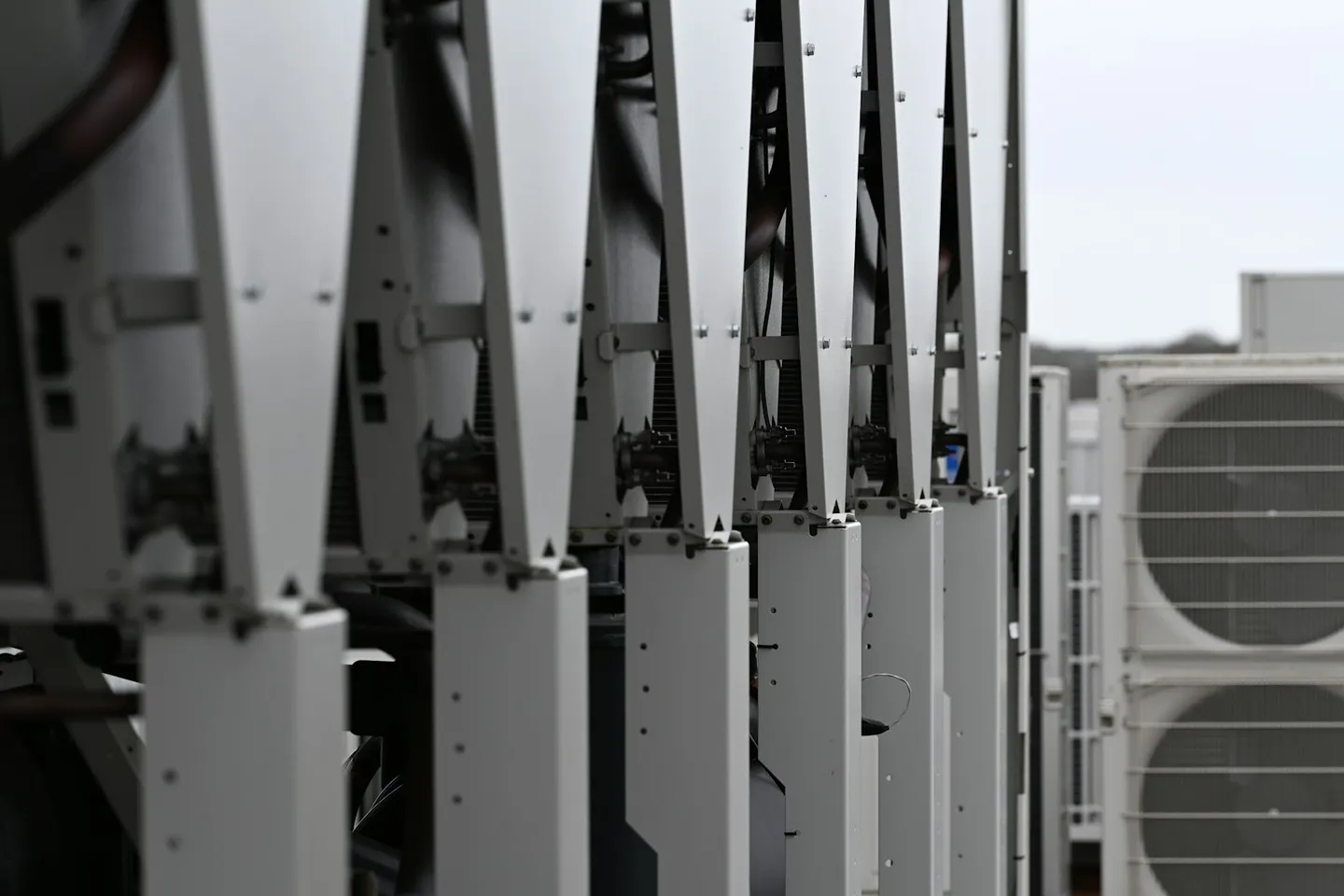
Photo: Row of white rooftop HVAC units. Photo by Carl Wragg on Unsplash.
Most commercial buildings still run HVAC sequences that a controls contractor wrote once, then never revisited. Fixed supply-air temperatures. Fixed duct static. Schedules that ignore empty floors. The plant works. The bill is higher than it needs to be, and the operators get more alarms than actionable faults.
ASHRAE Guideline 36 exists because that pattern is common. It publishes standardized high-performance sequences of operation for HVAC systems so designers and controls teams stop inventing every SOO from scratch. The current edition is Guideline 36-2024 (continuously maintained; later addenda exist for that edition). This Field Note is the operator cut: what G36 is at a public-summary level, which ideas existing buildings can borrow without a full BAS reprogram, and how metered ops data and analytics relate. It is not a substitute for the ASHRAE publication, and FrostLogic Explore is not an ASHRAE certifier or a Guideline 36 programmer.
What Guideline 36 is
Guideline 36 is ASHRAE’s library of high-performance sequences for common commercial HVAC systems. The intent, as industry explainers describe it, is energy efficiency plus indoor air quality plus diagnostics that operators can actually use. Instead of every project writing a unique narrative for each air handling unit, the guideline gives a shared starting point for how the plant should behave under load, under light occupancy, and when something fails.
That matters for two reasons. First, custom sequences drift. A project that was “high performance” in 2014 may still be running the same fixed setpoints while the building’s use has changed. Second, when every site invents its own SOO, fault detection becomes tribal knowledge. Standardized sequences make it easier to say what “normal” looks like, and therefore what a fault looks like.
Guideline 36 is still a design and controls document. Owning a copy does not mean your building complies. Compliance means the sequences are implemented, commissioned, and maintained. Borrowing a few ideas from the public conversation around G36 is useful. Claiming full Guideline 36 compliance without the commissioning work is not.
Sequences of operation in plain language
A sequence of operations (SOO) is the written rule set for how equipment should behave: when fans start, how setpoints move, how dampers and valves respond, what happens in unoccupied mode, and how the plant recovers from a fault. The BMS (or BAS) turns that narrative into control code. Graphics and alarms sit on top. The SOO is the contract between design intent and what the controller actually does.
Fixed setpoints waste energy for a boring reason. A constant supply-air temperature that was right for a design-day peak is often colder (or hotter) than zones need for most of the year. The VAV boxes then reheat or starve airflow to compensate. A constant duct static that was sized for full fan capacity keeps the fan working harder than the current zone requests require. The controller is “happy.” The meter is not.
High-performance sequences treat setpoints as things that should move with demand. Zone requests push the plant up when comfort or ventilation needs it. When requests drop, the plant trims toward savings. That idea shows up again and again in public G36 explainers under names like trim-and-respond and reset.
For how those sequences sit next to the wider HVAC control stack, see HVAC building management system.
Ideas existing buildings can borrow without reprogramming the whole plant
A full Guideline 36 retrofit means rewriting sequences, testing them, and commissioning the result. Many estates will not do that this year. They can still steal the direction of a few public concepts and apply them with the tools they already have: trend analysis, modest setpoint policy changes, and analytics that flag when the plant fights itself.
Trim-and-respond
Trim-and-respond is a feedback pattern, not a magic setpoint. Zones that need more cooling, heating, or static pressure raise a request. The AHU trims supply-air temperature or duct static toward a more efficient value when requests are quiet, then responds (moves the setpoint the other way) when requests pile up. The plant rides closer to what the zones actually need instead of sitting at a design-day extreme all day.
You do not need a full G36 rewrite to ask whether your AHUs ever leave their fixed SAT or static. If the answer is no, and zone complaints are rare, there is usually headroom. Start by trending zone demands against SAT and duct static over a few weeks. That is ops homework, not a reprogram.
Supply-air temperature and duct static resets
On multi-zone VAV AHUs, supply-air temperature reset and duct static-pressure reset are the two levers most operators already understand. Raise SAT when zones are satisfied and outdoor conditions allow. Lower duct static when boxes are not starving. Both cut fan and coil load when the building is lightly loaded.
Existing buildings often already have the points. What they lack is a policy that moves those setpoints, and a check that the reset actually happened. Analytics that watches setpoint tracking helps here: if SAT is supposed to float and the trend shows a flat line forever, the sequence is not doing the job the graphic claims.
AFDD awareness without a checklist dump
Automated fault detection and diagnostics (AFDD) is part of the G36 conversation because high-performance sequences assume sensors and actuators tell the truth, and that operators get usable fault messages when they do not. Stuck dampers, sensor drift, simultaneous heating and cooling, and valves that never leave mid-stroke are not exotic. They are the everyday reasons a “smart” sequence fails in the field.
You do not need to paste Guideline 36 fault tables into your CMMS. You do need point coverage good enough that those failures leave a signature, and a queue that ranks them instead of burying them in alarm noise. That is the ops half of AFDD: make faults visible and actionable, even before you rewrite the SOO.
Related ideas that often travel with G36 thinking
Optimum start, night setback, cutting simultaneous heating and cooling, and occupancy-aware HVAC (including demand-controlled ventilation on the outdoor-air side) sit in the same family of “stop running design-day all day.” None of them require you to claim Guideline 36 compliance. All of them need trustworthy schedules, sensors, and a habit of checking whether the plant did what the policy said.
What you still need
Borrowing ideas is not the same as running Guideline 36.
You still need point coverage: temperatures, flows, damper and valve positions, fan speeds, and zone requests that the sequences actually use. You still need zone feedback so trim-and-respond has something to trim against. You still need commissioning discipline: a changed setpoint policy that was never verified is just a story on a slide.
And you still need honesty about scope. Enabling a SAT reset on two AHUs is progress. It does not make the building a Guideline 36 reference site. Keep the language accurate when you talk to ownership, auditors, or an ESCO.
How Explore relates (without pretending to be G36)
FrostLogic Explore is Sensor Intelligence for commercial and industrial estates. It reads the meters, BMS and sensors you already run and returns a ranked queue of waste and faults. It is not a CMMS, not a BAS replacement, and not an ASHRAE Guideline 36 implementation service. It does not certify compliance.
What it does offer that rhymes with the G36 conversation:
Fault and anomaly detection, including setpoint tracking. History-based detectors miss chronic faults that look “normal” because they have always been wrong. Setpoint tracking catches the SAT that never moves, the static that never drops, and the valve that never leaves 40%.
Energy Savings Loop detectors that watch levers operators already care about: supply reset behaviour, ventilation trim, flat setpoints that should float, deadband overlap that drives simultaneous heat and cool. The loop measures approved changes at 7, 14 and 28 days against a weather-normalised baseline. There is no estimated-savings tier and no marketing percentage attached.
Smart Schedules AHU-related templates (including demand-controlled ventilation, night flush, heat recovery, supply-air reset and plant resets) are available or in pilot depending on the estate. They are default-off. Once a schedule is approved, the LLM is not in the control loop.
Writes are permissioned scopes. New installs start read-only by default; you grant write scopes one at a time when you want write-back, with human review or auto-run inside that scope. How that leash works is under Explore Automation. The commercial path for the ranked BMS queue is BMS analytics; degradation ranked by urgency sits under predictive maintenance.
Guideline 36 remains the sequences standard. Explore’s job is to show whether the plant is following the policy you think you have, and whether changes hold after you approve them.
FAQ
What is ASHRAE Guideline 36? ASHRAE Guideline 36 is a continuously maintained publication of high-performance sequences of operation for HVAC systems. The current edition is Guideline 36-2024. It gives designers and controls teams standardized SOOs instead of inventing every sequence from scratch, with intent around energy, indoor air quality and diagnostics.
How does Guideline 36 differ from a custom sequence of operations? A custom SOO is project-specific narrative and code. Guideline 36 is a shared library of high-performance sequences meant to be adapted and commissioned. Custom work can be excellent; G36 exists so teams are not forced to invent the same patterns site by site.
Can existing buildings use Guideline 36 ideas without reprogramming the whole BAS? Yes, in a limited way. You can trend whether SAT and duct static ever leave fixed values, tighten simultaneous heat/cool, improve schedules, and use analytics to flag stuck actuators and flat setpoints. That is borrowing direction. Full G36 still needs sequence implementation and commissioning.
What is trim-and-respond in one paragraph? Trim-and-respond lets zone requests pull AHU setpoints (such as supply-air temperature or duct static) toward savings when demand is quiet, then push them back when requests pile up. The plant rides closer to real load instead of sitting at a design-day extreme all day.
What role does AFDD play next to Guideline 36? AFDD (automated fault detection and diagnostics) makes sensor and actuator problems visible so high-performance sequences are not defeated by silent failures. Explore ranks those signatures from existing points; it does not replace a formal AFDD specification or a G36 commissioning report.
Does FrostLogic Explore implement Guideline 36 or certify compliance? No. Explore is not an ASHRAE certifier, not a Guideline 36 programmer, and not a compliance certificate. It detects faults and waste (including setpoint tracking), runs Energy Savings Loop checks on approved changes, and offers Smart Schedules templates that are available or in pilot and default-off. Sequences and certification stay with your design and controls partners.
Do I need new hardware to start? Usually no. Most of the borrowable ideas use points already on the BMS: SAT, duct static, zone temperatures, damper and valve positions, fan speed. The gap is policy and visibility, not another sensor SKU.
What's your building not telling you?
If your AHUs still run fixed setpoints while the floors empty out, bring the points you already have. We listen first, then say straight whether Explore’s ranked queue helps on your estate. 30 or 60 minutes, your pick. No commitment either way. Talk it through.
FrostLogic Explore brings sensor intelligence, scenario simulation, and grounded-inference AI to commercial and industrial buildings. Learn more about Sensor Intelligence or talk it through with us.
Curious how this would look on your building?
What's your building not telling you?
Twelve questions about your building. About two minutes. Free. You get a Building Intelligence Score. No pitch.