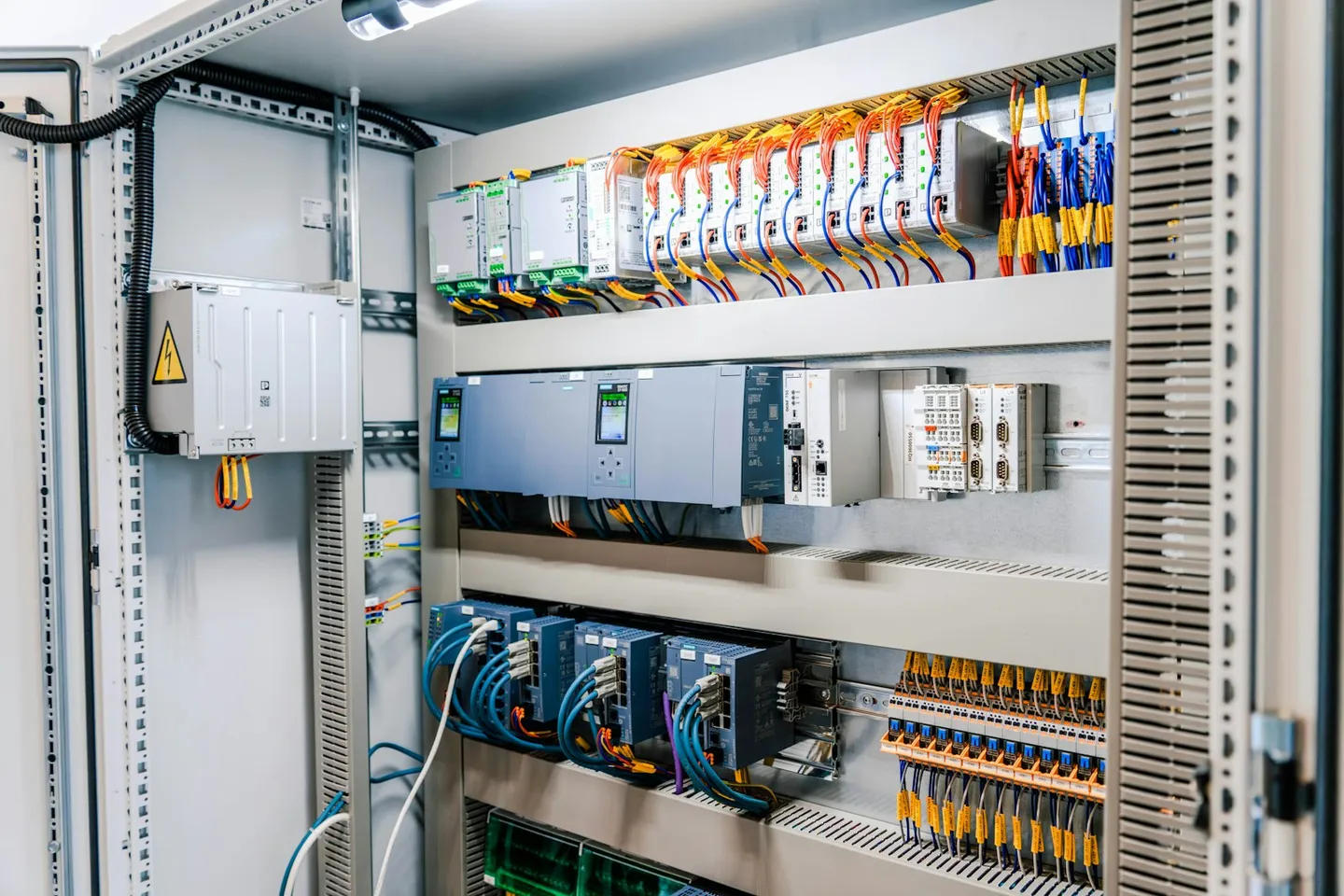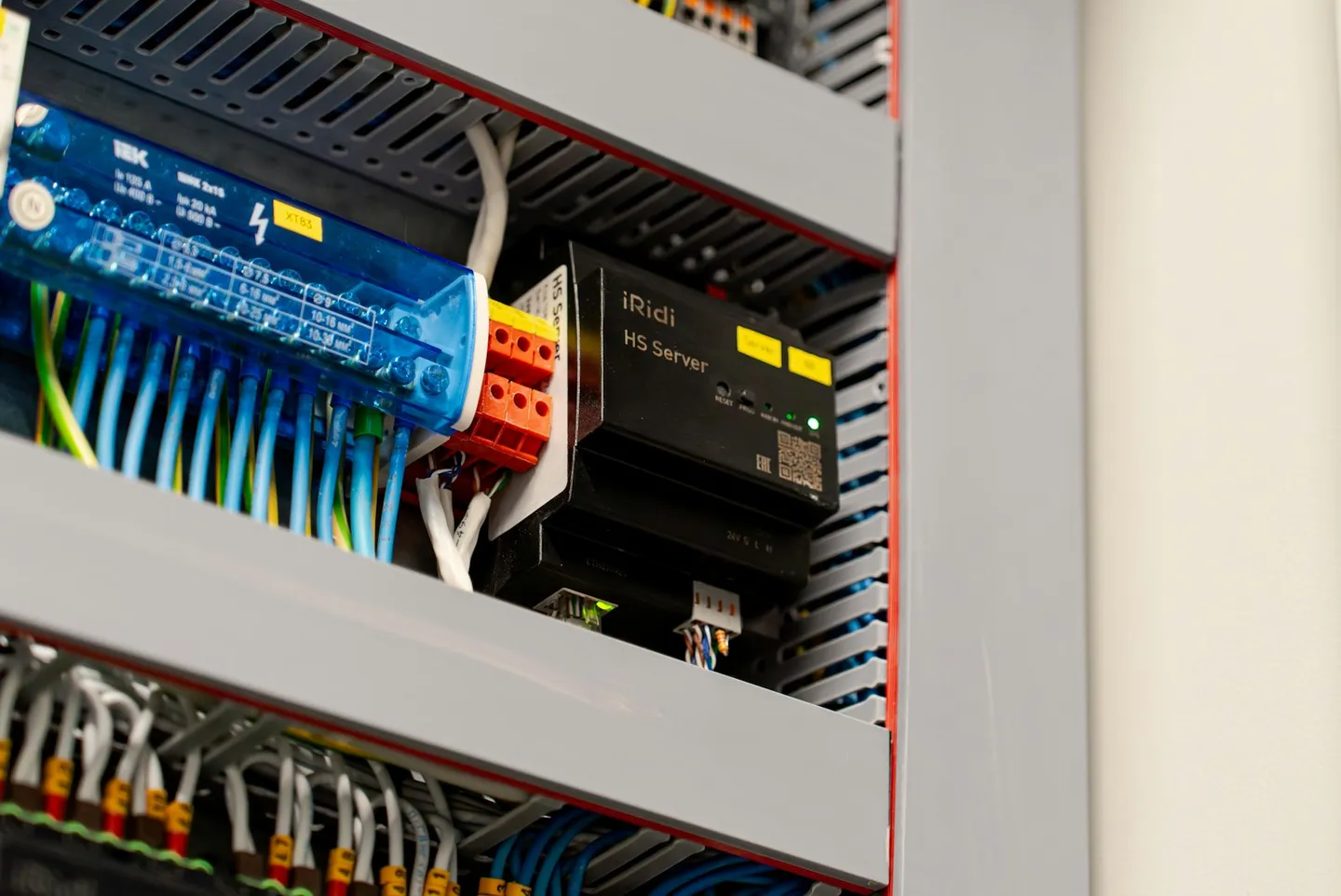
Photo: Electrical panel with wires and automation components. Photo by Aleksandr Lyaptsev on Unsplash.
Portfolio analytics projects rarely stall because BACnet is missing. They stall because the point
list looks like AHU4B_SAT, TT_17_NEW and TEMP_COPY_2. The network is fine. The integrator left. Nobody still knows
which supply-air temperature that first tag was meant to be.
BACnet point naming conventions are how you stop that. The protocol will move values either way. What it will not do is invent a human-readable name for you. That job sits with the owner, the BAS specification and the people who commission the BMS.
BACnet does not mandate a naming syntax
BACnet defines an object model. It does not define a naming grammar. When operators say "point," they usually mean a BACnet object that exposes a live value: an Analog Input for a sensor, an Analog Value for a calculated temperature, a Binary Output for a fan command. The object has a type, an instance number and a set of properties. One of those properties is Object_Name.
Object_Name must be unique within the device that owns it. On many internetworks, teams also treat uniqueness across the
visible network as a practical rule so a workstation or analytics agent does not collide two devices that both called
something SA_TEMP. Description and Location are companion properties: Description holds the longer human phrase;
Location often carries the panel, room or plant label. Industry practice papers from the BACnet community (including
Butler and Veelenturf on point naming standards, and NIST guidance on Facility-System-Point patterns) treat naming as
owner discipline layered on top of the protocol, not as something ASHRAE encodes as a fixed string format.
BACnet object types and object identifiers give machines a stable address. They do not tell a facilities engineer which
physical sensor is which when the label is TEMP_COPY_2. Object_Name, Description and Location are the human layer. Use
them on purpose.
So "what is BACnet" at protocol level is settled elsewhere. Here the question is narrower: once objects exist, how do you label them so the next person, and the next analytics layer, can still find them.
A workable hierarchy: Facility · System · Point (FSP)
A pattern that has aged well is Facility · System · Point, often abbreviated FSP. NISTIR and later BAS practice notes describe it as a dotted or delimited hierarchy that starts with the site or building, then the mechanical system, then the specific measurement or command.
Worked examples:
BLDG226.AHU1.MA_TEMP: building 226, air-handling unit 1, mixed-air temperatureBLDG20.AHU4.SA_TEMP: building 20, AHU 4, supply-air temperatureCAMPUS.BLDG3.CHWP2.STATUS: campus estate, building 3, chilled-water pump 2, run status
The separators and abbreviation dictionary are estate choices. Some campuses use hyphens (FCU-3-DA-T for fan-coil unit
3, discharge-air temperature). Universities and large public estates publish their own System-ControlPoint patterns for
exactly this reason. The shape matters less than consistency: one dictionary owned by the building owner (or the
portfolio controls standard), not a different shorthand from every vendor job.
Keep the dictionary short enough that commissioning engineers will use it. If every new job invents SAT, SA_T,
SUPPLYTEMP and TEMP_SA for the same physical idea, FSP has already failed. Publish the dictionary with the point
list of record, and require contractors to reference it by revision in their submittals.
Mapping the scheme into BACnet properties
Write the convention into BACnet properties, not only into a spreadsheet.
Object_Name is the primary short label. On many controllers it is writable during commissioning. On some manufacturer-locked devices it is fixed at the factory or only changeable through a proprietary tool. Ask before the first point list lands. If Object_Name cannot carry the FSP string, put the full convention into Description and keep Object_Name as close as the product allows.
Description is the fallback humans actually read in a workstation. Prefer the same FSP stem plus a plain phrase
(BLDG20.AHU4.SA_TEMP: AHU-4 supply air temperature) rather than a novel sentence that never appears in the export.
Location is useful for site and panel context when the name itself is already dense. It should not become a dumping ground for the entire hierarchy if Object_Name is empty.
Character-length and charset limits vary by product. Some stacks truncate at a few dozen characters; others choke on spaces or non-ASCII. Confirm limits with each vendor on a multi-brand estate. Discovering a 32-character hard stop after you have named 8,000 points is expensive.
Object identifier (type + instance) and device instance (the BACnet device ID) are different layers. The device ID addresses the controller on the network. The object identifier addresses one object inside that device. Neither replaces Object_Name for humans. Operators search names; gateways and agents still need stable identifiers under the hood.
Multi-vendor jobs and the point list of record
Specify the naming convention in the BAS / BMS tender documents. Require that Object_Name (or Description, where Object_Name is locked) matches the estate dictionary at practical completion. Keep the names in the devices. A spreadsheet that diverges from the live object list is not a point list of record; it is a second source of truth that rots.
On multi-vendor estates you will meet Desigo, EcoStruxure, Niagara, Metasys and Trend side by side. Each tool has its
own default tags. The estate standard has to win, or every handover reintroduces TT_17_NEW. Campus-style patterns such
as FCU-3-DA-T are valid if the whole portfolio uses them. Pick one shape estate-wide and stick to it. When a retrofit
adds a new controller brand, run a naming compliance check in the same pass as the network and trend checks, not as a
tidy-up six months later.
The hardware story underneath those names is the BMS controller, panel and field-device stack. Naming does not replace good panel schedules; it is what makes those schedules usable five years later.
Why messy names break analytics
Messy BACnet naming conventions tax every layer above the controller.
Mapping cost rises first. An analytics engineer spends days guessing whether AHU4B_SAT is supply air, mixed air or a
spare. False fault-detection rules follow: a rule that expects a discharge-air temperature fires on the wrong object and
looks clever until someone checks the plant. Silent sensor drift gets mis-attributed because the wrong twin was bound.
Any analytics layer that binds over BACnet, Modbus, OPC UA or oBIX depends on named objects it can resolve and keep resolving after a controller swap. FrostLogic Explore is one of those layers: it reads the points your existing building automation already exposes, ranks what to fix, and can write back through the FrostLogic Edge Agent once you grant a scope. Connection is read-only by default; write access starts off and is granted per scope, with writes after human review or automatically inside permissioned scopes. The binding still fails if the names are unusable. See BMS analytics for how that reading layer sits above the control stack, and the protocol guide when the estate mixes BACnet with Modbus or OPC UA.
Semantic tags as a complement
Haystack, Brick and similar tagging schemes help portfolio tools normalise meaning across sites. They complement
human-readable Object_Names; they do not replace them. Operators still open a workstation and need a string they
recognise. Ship both when the estate is ready. Do not wait for a full ontology project before fixing TEMP_COPY_2.
FAQ
Does BACnet require a naming standard? No. BACnet requires unique Object_Names within a device and defines object types and properties. The readable Facility-System-Point (or campus System-ControlPoint) convention is owner and specification practice layered on top of the protocol.
What is the difference between Object_Name and Description? Object_Name is the short primary label used in lists, exports and most bindings. Description is the longer companion string. Prefer putting the estate convention into Object_Name when the product allows; use Description when Object_Name is manufacturer-locked or length-limited.
What is FSP in BACnet point naming? Facility · System · Point: a hierarchy such as BLDG20.AHU4.SA_TEMP that names
the building, the mechanical system and the specific measurement or command. It is guidance from industry practice
(including NIST-era FSP notes), not a mandatory BACnet clause.
How does a BACnet device ID differ from an object name? The device instance (device ID) identifies the controller on the BACnet network. An object identifier (type + instance) identifies one object inside that device. Object_Name is the human-readable label for that object. You need all three for a maintainable estate; the name is what people search.
How long can BACnet object names be? It depends on the product. Length and allowed characters vary by manufacturer and tool. Confirm limits before mass-renaming, especially on mixed-vendor networks.
What are common BACnet object types used as "points"? Analog Input, Analog Output, Analog Value, Binary Input, Binary Output, Binary Value and Multi-state variants cover most sensor, setpoint and status points. The object type tells you the data shape; the name tells you which plant it belongs to.
How do point names relate to BMS controllers and field devices? Controllers expose objects for the sensors and actuators wired into the panel. Naming conventions label those objects so the field-device map stays usable after handover. For the hardware anatomy, see the BMS controller article.
Will better names alone fix analytics? No. Names remove mapping guesswork and false bindings. You still need working trends, sane sampling and an analytics layer that can read the protocols you run. Clean names make that layer cheaper and more trustworthy; they do not replace it.
What's your building not telling you?
If your point list already looks like a crossword of abbreviations, start with the convention, then decide whether an analytics layer is next. Tell us what you are trying to figure out. We listen first, then say straight whether Explore helps. 30 or 60 minutes, your pick. No commitment either way. Talk it through.
FrostLogic Explore brings sensor intelligence, scenario simulation, and grounded-inference AI to commercial and industrial buildings. Learn more about Sensor Intelligence or talk it through with us.
Curious how this would look on your building?
What's your building not telling you?
Tell us what you're trying to figure out: energy drift, a BMS you don't trust, compliance you're chasing. We listen first, then tell you straight whether Explore helps. 30 or 60 minutes, your pick. No commitment either way.