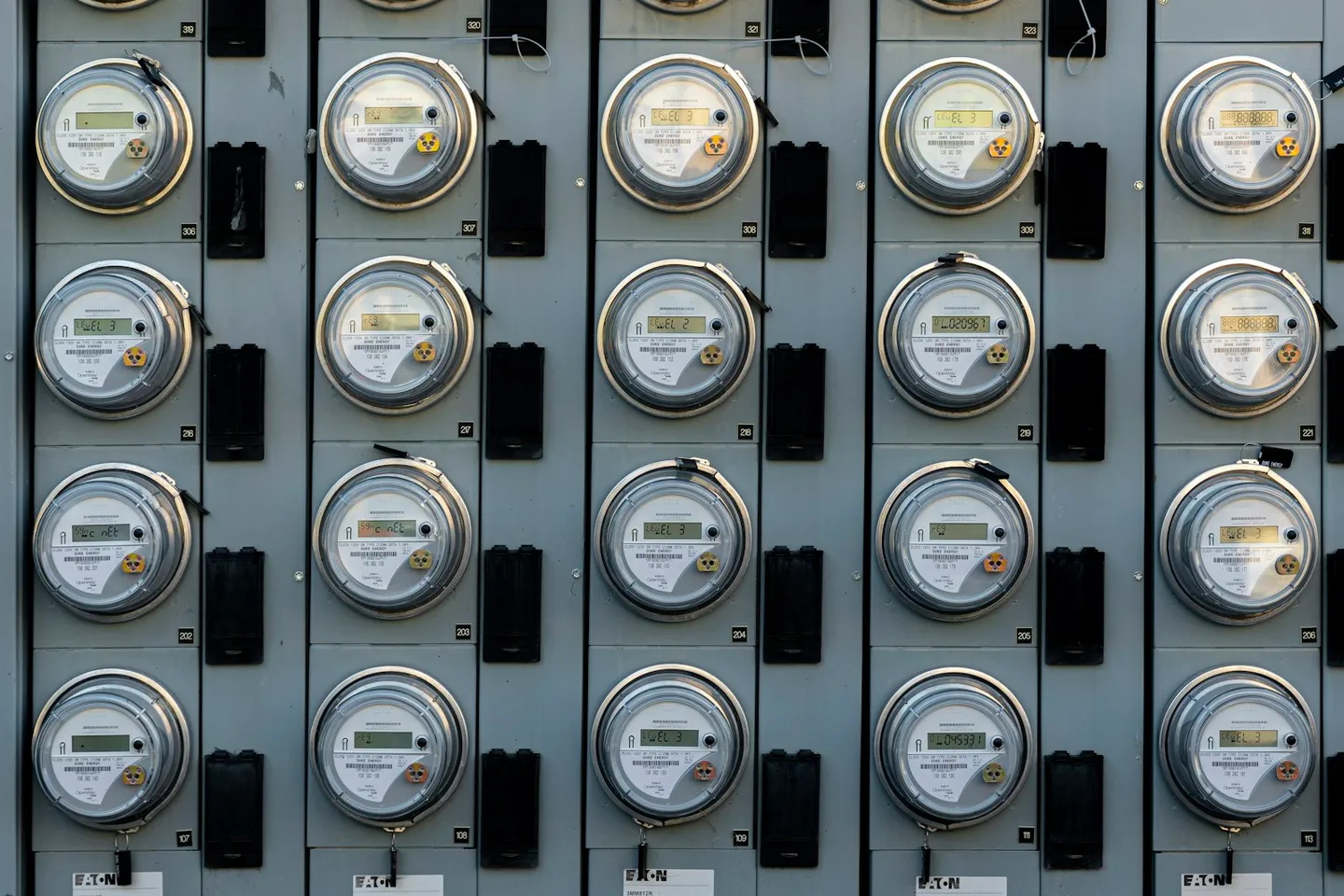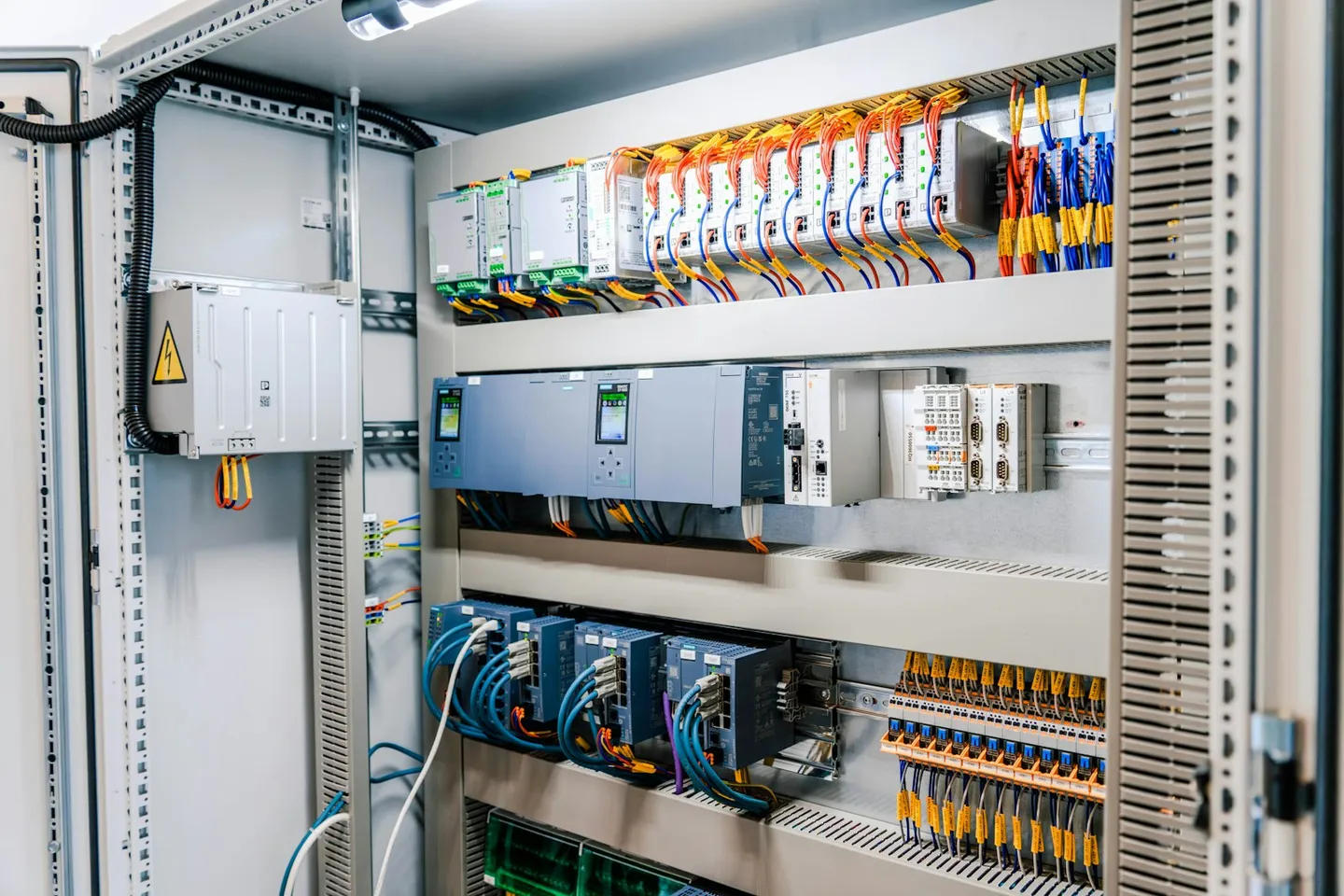
Photo: Open control panel with I/O modules and terminal wiring. Photo by Raymond Sime on Unsplash.
A BMS controller is a small industrial computer that runs a building's heating, cooling, lighting or air-handling logic. It is not a Battery Management System controller, the chip that balances cells in an EV or a storage pack. Same three letters, unrelated field. If you landed here looking for battery electronics, this is the wrong page.
This article is the hardware layer underneath our BMS glossary entry, which covers what a building management system is at a system level. Here we go one step down: what a controller actually does, what's physically inside the panel it lives in, the field devices wired to it, and where an analytics layer like FrostLogic Explore sits once the control hardware is already in place.
What a BMS controller does: the DDC loop
Every BMS controller runs the same basic pattern, direct digital control, usually shortened to DDC. A sensor reports a value: supply-air temperature, CO2 level, duct pressure. The controller's logic compares that value against a setpoint and a control algorithm, typically PID (proportional-integral-derivative), and calculates an output. An actuator then moves: a valve opens a few degrees, a damper closes, a fan speeds up. The loop repeats, usually several times a second, for as long as the plant runs.
That sense-decide-act cycle is what makes it "direct" digital control: the controller reads its own field points and drives its own field outputs, without waiting on a human or a central server for each cycle. A single controller might run one loop (a variable-air-volume box holding a zone temperature) or dozens (an air-handling unit sequencing heating, cooling, mixed-air dampers and fan speed together). Building automation controllers of this kind ship as purpose-built hardware from vendors such as Siemens, Schneider Electric, Honeywell, Trend and Johnson Controls, and increasingly as software-defined controllers running on a Niagara framework or similar platform. The DDC concept is the same regardless of the box it runs in.
DDC controllers vs. supervisory controllers
Not every controller in a BMS does the same job. The hierarchy usually has two levels.
DDC (or field, or terminal) controllers run local loops close to the plant: one per air-handling unit, one per floor's VAV boxes, one per chiller. They hold their setpoints and schedules even if the network drops. A DDC controller with a lost connection keeps the zone at temperature; it just stops reporting in.
Supervisory controllers sit above the field layer and coordinate. They don't usually run a tight sensor-to-actuator loop themselves. Instead they push schedules and global setpoints down to the DDC controllers, collect trend and alarm data back up, and give operators one place to change a time schedule instead of forty. In a small building the supervisory role might be a single head-end PC; in a large estate it's a dedicated server, sometimes a whole BACnet or Niagara network of them.
That two-level split is what people mean when they talk about "BMS controls" as a system rather than a single device: the field controllers hold the physics, the supervisory layer holds the coordination, and the network protocol between them, usually BACnet, sometimes Modbus, carries both trend data going up and setpoint changes coming down.
Inside a BMS control panel
The controller itself is one component in a BMS control panel, the metal enclosure an electrician mounts on a plant room wall. Open one up and you'll typically find:
- The controller board (or boards). The DDC logic described above, often with a small local display or commissioning port.
- I/O modules. Input/output cards that translate field wiring into signals the controller can use: analogue inputs for temperature and pressure sensors, digital inputs for status contacts, analogue outputs for modulating actuators, digital (relay) outputs for on/off equipment like pumps and fans. A controller with more points than its onboard I/O supports gets expansion modules wired alongside it.
- Terminal strips. Numbered screw terminals where every field wire lands, matched against the panel's wiring schedule. This is where an integrator or commissioning engineer actually works, tracing a faulty point back to its terminal rather than a line of code.
- Power supplies, fusing and a network interface, usually an RS-485 or Ethernet drop for BACnet, Modbus or a proprietary bus back to the supervisory layer.
A single BMS panel might hold one controller for a rooftop unit, or several controllers sharing a panel for a whole mechanical room. The panel is packaging and wiring; the controller inside it is what actually runs the logic. "BMS panel" and "BMS control panel" both refer to this enclosure; the terms are used interchangeably on site and in specifications.
Field devices: what the controller reads and drives
A controller is only as good as what's wired to it. Field devices split into two families.
Sensors feed information in: temperature and humidity sensors, CO2 and air-quality sensors, differential pressure sensors across filters or ducts, flow meters, occupancy and light-level sensors, current transformers on motors, and status contacts that report whether a piece of equipment is actually running. Most report as a 4-20mA current loop, a 0-10V analogue signal, or increasingly as a native BACnet or Modbus point on a smart device that skips the analogue conversion entirely.
Actuators carry the controller's decision out: modulating or on/off valve actuators on heating and cooling coils, damper actuators on air-handling units and VAV boxes, variable-frequency drives on fans and pumps, and relays that switch lighting circuits or start motors. An actuator's job is narrow: move to the position the controller commands. That is exactly why the intelligence sits in the controller, not the device.
Between sensor and actuator sits the loop described earlier: the controller is the only part of the chain that decides anything.
Building automation controllers and BMS control systems: same hardware, different names
"BMS controller", "building automation controller" and "building management system controller" describe the same hardware; which phrase you hear usually just tracks which market segment or vendor documentation you're reading. Building automation is the BAS-flavoured term, BMS the UK/European default. "BMS control system" and "BMS controls" describe the assembly of controllers, panels, field devices and supervisory software as a whole, rather than any single box. None of these terms name a Battery Management System part, and none of them describe an analytics platform. A BMS control system runs the plant; it doesn't rank faults or forecast drift on its own.
Where the analytics layer plugs in
None of the hardware above changes when an analytics layer arrives. FrostLogic Explore reads the same points the DDC and supervisory controllers already expose, over BACnet, Modbus, OPC UA or oBIX, the same protocols an integrator would use to commission the panel in the first place. It sits above the control stack the way the BMS glossary entry describes: it reads trend data, runs detection and forecasting, and turns raw controller telemetry into a ranked queue of what to fix. See BMS analytics in FrostLogic Explore for how that reading layer works, and the integrations hub for the vendor-specific connection paths (Siemens Desigo, Schneider EcoStruxure, Honeywell Niagara, Johnson Controls Metasys, Honeywell Trend among them).
Write-back is a separate, optional layer on top of that read path. Through the FrostLogic Edge Agent, Explore can propose a setpoint or schedule change with its reasoning and expected effect, then write it back to the controller, either after a person reviews and approves it or automatically inside a scope you've explicitly granted. Write access starts off on every install; nothing moves at the controller until an operator turns a scope on. That model, and how scopes are granted one at a time, is covered in full on the automation page. Either way, the DDC loop described at the top of this article is still what executes the change. Explore proposes and, where permissioned, writes; the controller still runs the physics.
FAQ
What does a BMS controller actually control? A BMS controller runs a direct digital control (DDC) loop for one piece of plant or one zone: it reads a sensor, compares the value to a setpoint, and drives an actuator or a relay to correct the difference. One air-handling unit or VAV box is typically served by one controller running several such loops at once.
Is a BMS controller the same as a Battery Management System controller? No. They share an acronym and nothing else. A Battery Management System (also often shortened to BMS) controller monitors and balances the cells in a battery pack, in an EV or a storage system. A building management system controller runs HVAC, lighting and other building plant. This article is about the building kind.
What's the difference between a DDC controller and a supervisory controller? A DDC controller runs a local sense-decide-act loop and keeps working even if the network drops. A supervisory controller sits above the field layer, pushes schedules and global setpoints down, and pulls trend and alarm data up to an operator interface. Most buildings have several DDC controllers reporting to one supervisory layer.
What's inside a BMS control panel? Typically a controller board, I/O modules that translate field wiring into usable signals, terminal strips where the field wiring lands, a power supply, and a network connection back to the supervisory layer. "BMS panel" and "BMS control panel" refer to the same enclosure.
Do I need to replace my BMS controllers to add analytics? No. An analytics layer such as FrostLogic Explore reads the points your existing controllers already expose over BACnet, Modbus, OPC UA or oBIX. It doesn't replace the controller's DDC logic or the control panel it lives in. It reads alongside it, and write-back, if you enable it, is a separate permissioned layer on top.
Which vendors make BMS controllers? Siemens (Desigo), Schneider Electric (EcoStruxure), Honeywell (including Niagara-based platforms), Trend and Johnson Controls (Metasys) are the ones most commonly found on commercial estates. A large portfolio usually runs several of these side by side, often from different eras, which is one reason a vendor-neutral analytics layer on top is useful.
Want to see what an analytics layer finds once it reads your existing controllers? Talk it through with us, or get your Building Intelligence Score for a free, twelve-question view of where the building is leaking value.
FrostLogic Explore brings sensor intelligence, scenario simulation, and grounded-inference AI to commercial and industrial buildings. Learn more about Sensor Intelligence or talk it through with us.
Curious how this would look on your building?
What's your building not telling you?
Tell us what you're trying to figure out: energy drift, a BMS you don't trust, compliance you're chasing. We listen first, then tell you straight whether Explore helps. 30 or 60 minutes, your pick. No commitment either way.